For each statement, indicate whether it is true or false. (d) Nonbonding electron pairs cannot occupy a hybrid orbital.
Ch.9 - Molecular Geometry and Bonding Theories

Brown15th EditionChemistry: The Central ScienceISBN: 9780137542970Non è quello che usi tu?Cambia libro di testo
Tutti i libri di testo
Brown 15th Edition
Ch.9 - Molecular Geometry and Bonding Theories
Problema 46b,c
Brown 15th Edition
Ch.9 - Molecular Geometry and Bonding Theories
Problema 46b,cCapitolo 9, Problema 46b,c
Draw sketches illustrating the overlap between the following orbitals on two atoms: (b) the 2pz orbital on each atom (assume both atoms are on the z-axis) (c) the 2s orbital on one atom and the 2pz orbital on the other atom.
Guida verificata passo dopo passo1
Start by understanding that the 2pz orbitals are oriented along the z-axis, which means they extend above and below the nucleus along this axis.
Visualize each 2pz orbital as a dumbbell shape with two lobes, one above and one below the nucleus, aligned along the z-axis.
Consider the two atoms positioned along the z-axis, with their nuclei aligned. The 2pz orbitals from each atom will face each other.
Sketch the two 2pz orbitals such that their lobes overlap along the z-axis. The overlap occurs between the lobes of the orbitals that are facing each other.
Label the sketch to indicate the positive and negative phases of the orbitals, as this is important for understanding the type of bond (sigma or pi) that may form due to the overlap.

Risposta video verificata per un problema simile:
Questa soluzione video è stata consigliata dai nostri tutor come utile per risolvere questo problema.
Durata del video:
1mConcetti chiave
Ecco i concetti essenziali che devi comprendere per rispondere correttamente alla domanda.
Atomic Orbitals
Atomic orbitals are regions in an atom where there is a high probability of finding electrons. They are defined by quantum numbers and have distinct shapes, such as s, p, d, and f orbitals. The 2pz orbital, for example, is a type of p orbital that is oriented along the z-axis and has a characteristic dumbbell shape, which is crucial for understanding how atoms interact and bond.
Video consigliato:
Percorso guidato
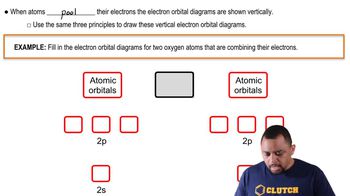
Atomic Orbitals Example
Orbital Overlap
Orbital overlap occurs when atomic orbitals from two atoms come into proximity, allowing their electron clouds to interact. This overlap is fundamental to the formation of covalent bonds, as it enables the sharing of electrons between atoms. In the case of two 2pz orbitals overlapping, the extent and nature of this overlap can influence the strength and characteristics of the bond formed.
Video consigliato:
Percorso guidato
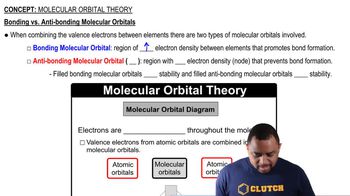
Molecular Orbital Theory
Molecular Geometry
Molecular geometry refers to the three-dimensional arrangement of atoms within a molecule, which is influenced by the types of bonds and the spatial orientation of the orbitals involved. The overlap of the 2pz orbitals on two atoms will affect the overall shape of the molecule, as well as its physical and chemical properties. Understanding molecular geometry is essential for predicting how molecules will interact in chemical reactions.
Video consigliato:
Percorso guidato
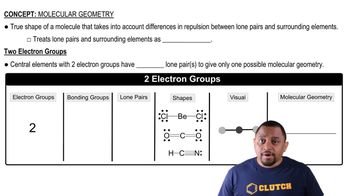
Molecular Geometry with Two Electron Groups
Pratica correlata
Domanda del libro di testo
520
views
Domanda del libro di testo
Draw sketches illustrating the overlap between the following orbitals on two atoms: (a) the 2s orbital on each atom
589
views
1
rank
Domanda del libro di testo
Consider the SCl2 molecule. (c) What hybrid orbitals should be constructed on the S atom to make the S-Cl bonds in SCl2?
807
views
Domanda del libro di testo
Consider the molecule BF3. (c) What hybrid orbitals should be constructed on the B atom to make the B–F bonds in BF3?
987
views
Domanda del libro di testo
Dichlorobenzene, C6H4Cl2, exists in three forms (isomers) called ortho, meta, and para:
Which of these has a nonzero dipole moment?
3
views
Domanda del libro di testo
Dichloroethylene (C2H2Cl2) has three forms (isomers), each of which is a different substance. (c) How many isomeric forms can chloroethylene, C2H3Cl, have? Would they be expected to have dipole moments?
2
views