The figure that follows contains ball-and-stick drawings of three possible shapes of an AF4 molecule. (a) For each shape, give the electron-domain geometry on which the molecular geometry is based. i.
Ch.9 - Molecular Geometry and Bonding Theories

Brown15th EditionChemistry: The Central ScienceISBN: 9780137542970Non è quello che usi tu?Cambia libro di testo
Capitolo 9, Problema 29a
Give the approximate values for the indicated bond angles in the following molecules: (a)
Guida verificata passo dopo passo1
Identify the central atom in the molecule.
Determine the electron domain geometry around the central atom using the VSEPR theory, which considers both bonding and non-bonding electron pairs.
Count the number of bonding pairs and lone pairs around the central atom to predict the molecular geometry.
Use the molecular geometry to estimate the bond angles. For example, in a tetrahedral geometry, the bond angles are approximately 109.5 degrees.
Consider any deviations from ideal bond angles due to factors such as lone pairs or double bonds, which can affect the angles.

Risposta video verificata per un problema simile:
Questa soluzione video è stata consigliata dai nostri tutor come utile per risolvere questo problema.
Durata del video:
2mConcetti chiave
Ecco i concetti essenziali che devi comprendere per rispondere correttamente alla domanda.
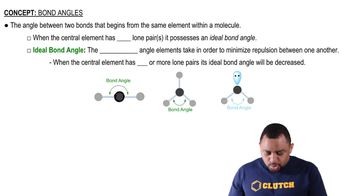
Bond Angles
Bond angles are the angles formed between two adjacent bonds at a central atom in a molecule. They are crucial for understanding molecular geometry and are influenced by the arrangement of electron pairs around the central atom, which can be affected by factors such as lone pairs and the type of bonds (single, double, or triple).
Video consigliato:
Percorso guidato
Bond Angles
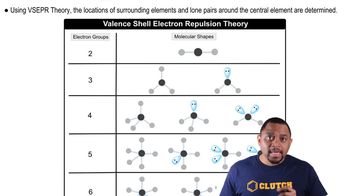
VSEPR Theory
Valence Shell Electron Pair Repulsion (VSEPR) theory is a model used to predict the geometry of individual molecules based on the repulsion between electron pairs in the valence shell of the central atom. According to VSEPR, electron pairs will arrange themselves to minimize repulsion, leading to specific bond angles characteristic of different molecular shapes.
Video consigliato:
Percorso guidato
Molecular Shapes and VSEPR
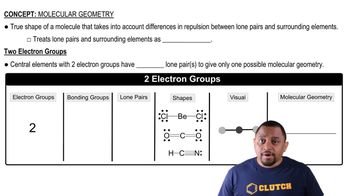
Molecular Geometry
Molecular geometry refers to the three-dimensional arrangement of atoms within a molecule. It is determined by the number of bonding pairs and lone pairs of electrons around the central atom, which influences the bond angles. Common geometries include linear, trigonal planar, tetrahedral, and octahedral, each with specific bond angle values.
Video consigliato:
Percorso guidato
Molecular Geometry with Two Electron Groups
Pratica correlata
Domanda del libro di testo
857
views
Domanda del libro di testo
Give the approximate values for the indicated bond angles in the following molecules: (d)
1408
views
Domanda del libro di testo
The figure that follows contains ball-and-stick drawings of three possible shapes of an AF4 molecule. (a) For each shape, give the electron-domain geometry on which the molecular geometry is based. ii.
364
views
Domanda del libro di testo
Give the approximate values for the indicated bond angles in the following molecules: (c)
489
views
Domanda del libro di testo
The figure that follows contains ball-and-stick drawings of three possible shapes of an AF4 molecule. (c) Which of the following elements will lead to an AF4 molecule with the shape in (iii): Be, C, S, Se, Si, Xe? i.
ii.
iii.
852
views
Domanda del libro di testo
Give the approximate values for the indicated bond angles in the following molecules: (a)
427
views