
Ch.9 - Molecular Geometry and Bonding Theories
Brown - Chemistry: The Central Science 15th Edition
Brown15th EditionChemistry: The Central ScienceISBN: 9780137542970Non è quello che usi tu?Cambia libro di testo
Capitolo 9, Problema 104a

One of the molecular orbitals of the H2− ion can be sketched as follows:
a. Is the molecular orbital a 𝜎 or 𝜋 MO? Is it bonding or antibonding?

Guida verificata passo dopo passo
1
Identify the type of molecular orbital (MO) by observing the symmetry of the electron cloud distribution around the internuclear axis. If the electron cloud is cylindrically symmetric around the axis, it is a sigma (𝜎) MO. If the electron cloud is oriented perpendicular to the axis, it is a pi (𝜋) MO.
Determine if the MO is bonding or antibonding by looking at the phase of the wave functions. Bonding orbitals have constructive interference (same phase) between atomic orbitals, leading to an increase in electron density between the nuclei. Antibonding orbitals have destructive interference (opposite phase), leading to a decrease in electron density between the nuclei.
Examine any nodal planes (regions of zero electron density) present in the MO. Bonding orbitals typically have fewer nodal planes than the corresponding antibonding orbitals.
Consider the energy level of the MO. Bonding orbitals are generally lower in energy compared to the atomic orbitals from which they form, while antibonding orbitals are higher in energy.
Use the molecular orbital theory to predict the stability of the molecule or ion. A molecule with more electrons in bonding orbitals than in antibonding orbitals is generally more stable.

Risposta video verificata per un problema simile:

Questa soluzione video è stata consigliata dai nostri tutor come utile per risolvere questo problema.
Durata del video:
4m

Concetti chiave

Ecco i concetti essenziali che devi comprendere per rispondere correttamente alla domanda.

Molecular Orbitals

Molecular orbitals (MOs) are formed by the combination of atomic orbitals when atoms bond together. They can be classified as bonding or antibonding. Bonding MOs lower the energy of the system and stabilize the molecule, while antibonding MOs increase energy and destabilize it. Understanding the type of molecular orbital is crucial for predicting the stability and properties of the molecule.
Video consigliato:
Percorso guidato
03:06
Molecular Orbital Theory

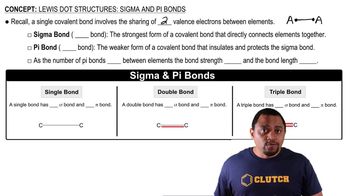
Sigma (𝜎) and Pi (𝜋) Bonds

Sigma (𝜎) and pi (𝜋) bonds are types of covalent bonds that arise from the overlap of atomic orbitals. A sigma bond is formed by the head-on overlap of orbitals, allowing for free rotation, while a pi bond results from the side-to-side overlap, restricting rotation. In molecular orbital theory, 𝜎 MOs are typically lower in energy than 𝜋 MOs, influencing the overall bonding characteristics of the molecule.
Video consigliato:
Percorso guidato
03:26
Lewis Dot Structures: Sigma & Pi Bonds

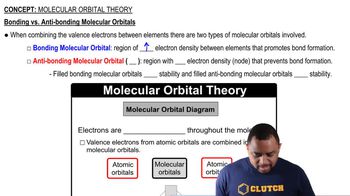
Bonding vs. Antibonding Orbitals

Bonding orbitals are formed when atomic orbitals combine constructively, leading to increased electron density between the nuclei, which stabilizes the molecule. Antibonding orbitals, on the other hand, result from destructive interference, creating a node between the nuclei and leading to decreased electron density in that region. The presence of electrons in antibonding orbitals can weaken or negate the bond formed by bonding orbitals.
Video consigliato:
Percorso guidato
03:06
Molecular Orbital Theory
Pratica correlata
Domanda del libro di testo

The structure of borazine, B3N3H6, is a six-membered ring of alternating B and N atoms. There is one H atom bonded to each B and to each N atom. The molecule is planar. (e) What are the hybridizations at the B and N atoms in the Lewis structures from parts (a) and (b)? Would you expect the molecule to be planar for both Lewis structures? Would you expect the molecule to be planar for both Lewis structures?

1743
views
Domanda del libro di testo

The highest occupied molecular orbital of a molecule is abbreviated as the HOMO. The lowest unoccupied molecular orbital in a molecule is called the LUMO. Experimentally, one can measure the difference in energy between the HOMO and LUMO by taking the electronic absorption (UV-visible) spectrum of the molecule. Peaks in the electronic absorption spectrum can be labeled as π2p-π2p*, σs-σ2s*, and so on, corresponding to electrons being promoted from one orbital to another. The HOMO-LUMO transition corresponds to molecules going from their ground state to their first excited state. (c) The electronic absorption spectrum of the N2 molecule has the lowest energy peak at 170 nm. To what orbital transition does this correspond?

2896
views
Domanda del libro di testo

The structure of borazine, B3N3H6, is a six-membered ring of alternating B and N atoms. There is one H atom bonded to each B and to each N atom. The molecule is planar. (a) Write a Lewis structure for borazine in which the formal charge on every atom is zero.

1459
views
Domanda del libro di testo

Azo dyes are organic dyes that are used for many applications, such as the coloring of fabrics. Many azo dyes are derivatives of the organic substance azobenzene, C12H10N2. A closely related substance is hydrazobenzene, C12H12N2. The Lewis structures of these two substances are

(Recall the shorthand notation used for benzene.) (b) How many unhybridized atomic orbitals are there on the N and the C atoms in each of the substances? How many unhybridized atomic orbitals are there on the N and the C atoms in hydrazobenzene?

674
views
Domanda del libro di testo

One of the molecular orbitals of the H2− ion can be sketched as follows:

d. Compared to the H—H bond in H2, the H—H bond in H2− is expected to be which of the following?

i. shorter and stronger

ii. longer and stronger

iii. shorter and weaker

iv. longer and weaker or

v. the same length and strength

2
views
Domanda del libro di testo

Place the following molecules and ions in order from smallest to largest bond order: H2+,B2,N2+,F2+, and Ne2.

2
views