Ch.9 - Molecular Geometry and Bonding Theories
Brown - Chemistry: The Central Science 15th Edition
Brown15th EditionChemistry: The Central ScienceISBN: 9780137542970Non è quello che usi tu?Cambia libro di testo
Capitolo 9, Problema 55d

Which of the following statements are true? d. A 𝜋 bond has two regions of overlap on opposite sides of the internuclear axis.

Guida verificata passo dopo passo
1
Understand the nature of a 𝜋 bond: A 𝜋 bond is formed by the sideways overlap of p orbitals.
Visualize the overlap: In a 𝜋 bond, the electron density is concentrated above and below the plane of the nuclei of the bonding atoms.
Identify the regions of overlap: The overlap occurs in two distinct regions, one above and one below the internuclear axis.
Compare with a 𝜎 bond: Unlike a 𝜎 bond, which has a single region of overlap along the internuclear axis, a 𝜋 bond has these two separate regions.
Conclude the statement: Based on the above understanding, determine if the statement about the 𝜋 bond having two regions of overlap on opposite sides of the internuclear axis is true.

Risposta video verificata per un problema simile:

Questa soluzione video è stata consigliata dai nostri tutor come utile per risolvere questo problema.
Durata del video:
46s

Concetti chiave

Ecco i concetti essenziali che devi comprendere per rispondere correttamente alla domanda.

Pi Bonding

A pi bond is a type of covalent bond formed when two lobes of one involved atomic orbital overlap with two lobes of another, typically occurring in double or triple bonds. Unlike sigma bonds, which have end-to-end overlap, pi bonds involve side-to-side overlap of p orbitals, resulting in a bond that is generally weaker and more reactive.
Video consigliato:
Percorso guidato
03:26
Lewis Dot Structures: Sigma & Pi Bonds

Orbital Overlap

Orbital overlap is a fundamental concept in molecular chemistry that describes how atomic orbitals combine to form bonds. The extent and orientation of this overlap determine the strength and type of bond formed, with sigma bonds resulting from head-on overlap and pi bonds from lateral overlap of orbitals.
Video consigliato:
Percorso guidato
03:06
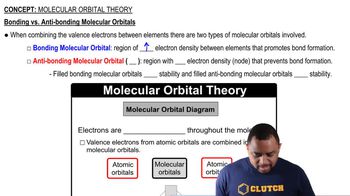
Molecular Orbital Theory

Internuclear Axis

The internuclear axis is an imaginary line that connects the nuclei of two bonded atoms. In the context of bonding, it is crucial for understanding the orientation of bonds; sigma bonds are aligned along this axis, while pi bonds are formed above and below it, leading to distinct geometrical arrangements in molecules.
Video consigliato:
Percorso guidato
02:07
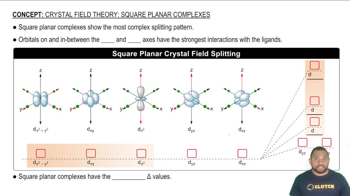
Square planar complexes show the most complex splitting pattern.