Ch.1 - Chemical Tools: Experimentation & Measurement
McMurry - Chemistry 8th Edition
McMurry8th EditionChemistryISBN: 9781292336145Non è quello che usi tu?Cambia libro di testo
Capitolo 1, Problema 7

A 25.5 g sample of a metal was placed into water in a gradu-ated cylinder. The metal sank to the bottom, and the water level rose from 15.7 mL to 25.3 mL. What is the identity of the metal? (LO 1.9) (a) Tin (density = 7.31 g/cm3) (b) Lead (density = 11.34 g/cm3) (c) Silver (density = 10.49 g/cm3) (d) Aluminum (density = 2.64 g/cm3)

Guida verificata passo dopo passo
1
First, we need to calculate the volume of the metal. We can do this by subtracting the initial volume of the water in the graduated cylinder from the final volume after the metal was added. In this case, the volume of the metal is 25.3 mL - 15.7 mL.
Next, we need to convert the volume of the metal from milliliters (mL) to cubic centimeters (cm^3) because the densities of the metals are given in g/cm^3. Remember that 1 mL is equivalent to 1 cm^3.
Now, we can calculate the density of the metal. Density is defined as mass divided by volume. In this case, the mass of the metal is 25.5 g and the volume is the value we calculated in the previous step.
Once we have the density of the metal, we can compare it to the densities of the metals given in the problem. The metal whose density is closest to the calculated density is likely to be the identity of the metal.
Remember that the densities given in the problem are average values. The actual density of a sample can vary slightly due to impurities or variations in temperature and pressure. Therefore, the metal with the density closest to the calculated value is the most probable identity of the metal, but it is not a definitive identification.

Risposta video verificata per un problema simile:

Questa soluzione video è stata consigliata dai nostri tutor come utile per risolvere questo problema.
Durata del video:
1m

Concetti chiave

Ecco i concetti essenziali che devi comprendere per rispondere correttamente alla domanda.

Density

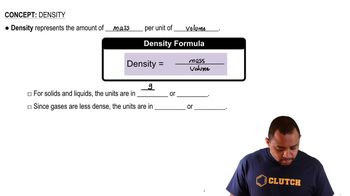
Density is defined as mass per unit volume, typically expressed in grams per cubic centimeter (g/cm³). It is a crucial property of materials that helps identify substances based on their physical characteristics. In this problem, the density of the metal can be calculated using the mass of the metal and the volume of water displaced, which corresponds to the volume of the metal.
Video consigliato:
Percorso guidato
01:56
Density Concepts

Displacement Method

The displacement method involves measuring the volume of liquid displaced by an object when it is submerged. This technique is used to determine the volume of irregularly shaped objects, such as the metal in this question. The change in water level in the graduated cylinder indicates the volume of the metal, which is essential for calculating its density.
Video consigliato:
Percorso guidato
01:11
Single Displacement Reactions

Identifying Metals by Density

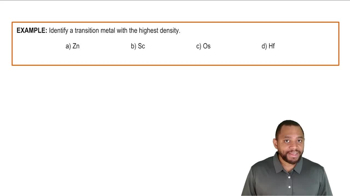
Different metals have characteristic densities that can be used for identification. By calculating the density of the metal sample from its mass and the volume of water displaced, one can compare the calculated density to known densities of various metals. This comparison allows for the identification of the metal in question based on the closest match to its density.
Video consigliato:
Percorso guidato
01:38
Atomic Radius and Density of Transition Metals Example
Pratica correlata
Domanda del libro di testo

The temperature on the surface of the Sun is 5778 K. What is the temperature in degrees Fahrenheit? (LO 1.6) (c) 10,920 °F

758
views

Domanda del libro di testo
Calculate the volume in liters of a rectangular object with dimensions 13.0 cm * 11.0 cm * 12.0 cm. (a) 1720 L (b) 1.72 L (c) 14.3 L (d) 2.41 L
826
views
Domanda del libro di testo
Consider 20 mL samples of the following liquids. Which sample has the largest mass? (LO 1.9) (a) Water (density = 1.0 g/mL) (b) Glycerol (density = 1.26 g/mL) (c) Ethanol (density = 0.79 g/mL) (d) Acetic acid (density = 1.05 g/mL
668
views
Domanda del libro di testo

The temperature on the surface of the Sun is 5778 K. What is the temperature in degrees Fahrenheit? (LO 1.6) (d) 9941 °F

505
views
1
rank
Domanda del libro di testo
The cylinder contains two liquids that do not mix with one another: water (density = 1.0 g/mL) and vegetable oil (density = 0.93 g/mL). Four different pieces of plastic are added to the cylinder. Which type of plastic is at the position indicated by the square object in the figure? (LO 1.10) (a) Polyvinyl chloride (density = 1.26 g/mL) (b) Polypropylene (density = 0.90 g/mL) (c) High-density polyethylene (density = 0.96 g/mL) (d) Polyethylene terephthalate (density = 1.38 g/mL)

518
views
Domanda del libro di testo

An electron with a mass of 9.1 * 10-28 g is traveling at 1.8 * 107 m/s in an electron microscope. Calculate the kinetic energy of electron in units of joules, and report your answer in scientific notation. (LO 1.11) (a) 1.5 * 10-16 J (b) 1.6 * 10-20 J (c) 2.9 * 10-13 J (d) 2.9 * 10-10 J

641
views