Ch.1 - Chemical Tools: Experimentation & Measurement
McMurry - Chemistry 8th Edition
McMurry8th EditionChemistryISBN: 9781292336145Non è quello che usi tu?Cambia libro di testo
Capitolo 1, Problema 111c

Answer the following questions. (c) A certain type of wood has a density of 0.40 g/cm3. What is the mass of 1.0 cord of this wood in kg, where 1 cord is 128 cubic feet of wood?

Guida verificata passo dopo passo
1
Convert the volume from cubic feet to cubic centimeters. Use the conversion factor: 1 cubic foot = 28316.8 cm^3.
Calculate the total volume in cubic centimeters by multiplying 128 cubic feet by the conversion factor.
Use the density formula: \( \text{Density} = \frac{\text{Mass}}{\text{Volume}} \) to find the mass. Rearrange the formula to solve for mass: \( \text{Mass} = \text{Density} \times \text{Volume} \).
Substitute the given density (0.40 g/cm^3) and the calculated volume in cm^3 into the mass formula to find the mass in grams.
Convert the mass from grams to kilograms by dividing by 1000, since 1 kg = 1000 g.

Risposta video verificata per un problema simile:

Questa soluzione video è stata consigliata dai nostri tutor come utile per risolvere questo problema.
Durata del video:
4m

Concetti chiave

Ecco i concetti essenziali che devi comprendere per rispondere correttamente alla domanda.

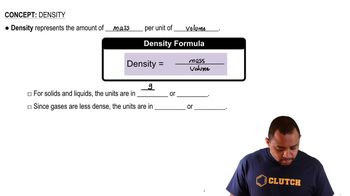
Density

Density is defined as mass per unit volume, typically expressed in grams per cubic centimeter (g/cm³) or kilograms per cubic meter (kg/m³). It is a crucial property that helps determine how much mass is contained in a given volume of a substance. In this question, the density of the wood is given as 0.40 g/cm³, which will be used to calculate the mass of the wood based on its volume.
Video consigliato:
Percorso guidato
01:56
Density Concepts

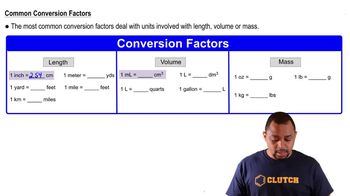
Volume Conversion

To solve the problem, it is necessary to convert the volume of wood from cubic feet to cubic centimeters, as the density is provided in g/cm³. One cord of wood is equivalent to 128 cubic feet, and knowing that 1 cubic foot equals approximately 28,316.8 cubic centimeters allows for the conversion. This step is essential to ensure that the units are consistent when calculating mass.
Video consigliato:
Percorso guidato
02:38
Common Conversion Factors

Mass Calculation

Mass can be calculated using the formula: mass = density × volume. Once the volume of the wood in cubic centimeters is determined, multiplying it by the density will yield the mass in grams. To convert this mass into kilograms, one must divide the result by 1,000, as there are 1,000 grams in a kilogram. This final step is necessary to express the mass in the desired unit.
Video consigliato:
Percorso guidato
03:12
Molar Mass Calculation Example
Pratica correlata
Domanda del libro di testo

Answer the following questions. (a) An old rule of thumb in cooking says: 'A pint's a pound the world around.' What is the density in g/mL of a sub-stance for which 1 pt = 1 lb exactly?

434
views

Domanda del libro di testo

Answer the following questions. (b) There are exactly 640 acres in 1 square mile. How many square meters are in 1 acre?

1064
views
Domanda del libro di testo

A bag of Hershey's Kisses contains the following information:

Serving size: 9 pieces = 41 g

Calories per serving: 230

Total fat per serving: 13 g

(a) The bag contains 2.0 lbs of Hershey's Kisses. How many Kisses are in the bag?

990
views
Domanda del libro di testo

Answer the following questions. (d) A particular sample of crude oil has a density of 0.85 g/mL. What is the mass of 1.00 barrel of this crude oil in kg, where a barrel of oil is exactly 42 gallons?

1028
views
Domanda del libro di testo

A bag of Hershey's Kisses contains the following information:

Serving size: 9 pieces = 41 g

Calories per serving: 230

Total fat per serving: 13 g

(b) The density of a Hershey's Kiss is 1.4 g/mL. What is the volume of a single Hershey's Kiss?

1058
views
Domanda del libro di testo
Lignum vitae is a hard, durable, and extremely dense wood used to make ship bearings. A sphere of this wood with a diameter of 7.60 cm has a mass of 313 g. (a) What is the density of the lignum vitae sphere? (b) Will the sphere float or sink in water? (c) Will the sphere float or sink in chloroform? (The density of chloroform is 1.48 g/mL.)
846
views