
Ch.1 - Chemical Tools: Experimentation & Measurement
McMurry - Chemistry 8th Edition
McMurry8th EditionChemistryISBN: 9781292336145Non è quello che usi tu?Cambia libro di testo
Capitolo 1, Problema 30

Assume that you have two graduated cylinders, one with a capacity of 5 mL (a) and the other with a capacity of 50 mL (b). Draw a line in each, showing how much liquid you would add if you needed to measure 2.64 mL of water. Which cylinder will give the more accurate measurement? Explain. Two graduated cylinders: a 5 mL cylinder and a 50 mL cylinder, showing liquid measurement for 2.64 mL.

Guida verificata passo dopo passo
1
Identify the two graduated cylinders: one with a capacity of 10 mL (left) and the other with a capacity of 5 mL (right).
Determine the scale of each graduated cylinder. The 10 mL cylinder has increments of 0.2 mL, and the 5 mL cylinder has increments of 0.1 mL.
To measure 2.64 mL of water, locate the 2.6 mL mark on the 5 mL cylinder and add a small amount to reach 2.64 mL. This cylinder allows for more precise measurement due to smaller increments.
On the 10 mL cylinder, locate the 2.6 mL mark and estimate the additional 0.04 mL. This cylinder is less precise due to larger increments.
Conclude that the 5 mL graduated cylinder will give a more accurate measurement of 2.64 mL of water because it has finer scale increments, allowing for more precise readings.

Risposta video verificata per un problema simile:

Questa soluzione video è stata consigliata dai nostri tutor come utile per risolvere questo problema.
Durata del video:
2m

Concetti chiave

Ecco i concetti essenziali che devi comprendere per rispondere correttamente alla domanda.

Graduated Cylinder Accuracy

Graduated cylinders are designed to measure liquid volumes accurately. The accuracy of a graduated cylinder depends on its size and the smallest division marked on it. A smaller cylinder, like the 5 mL one, typically has finer graduations, allowing for more precise measurements compared to a larger cylinder with broader divisions.
Video consigliato:
Percorso guidato
01:49
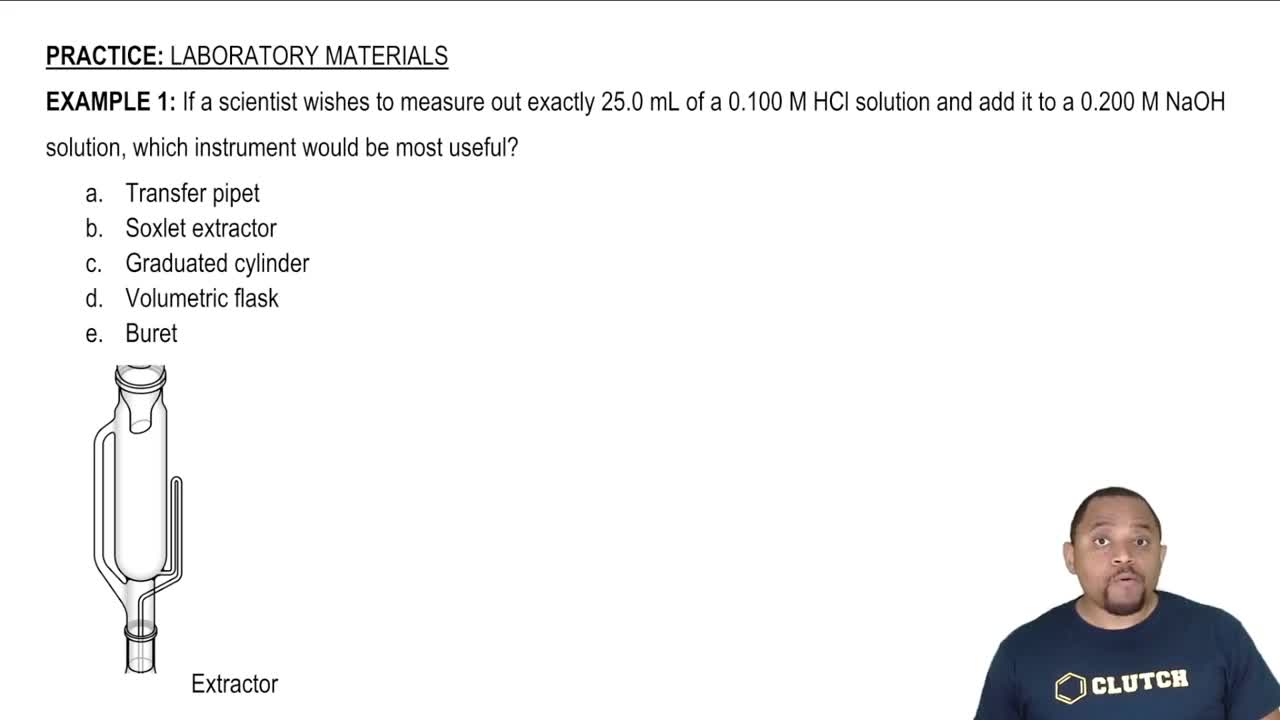
Laboratory Materials

Meniscus Reading

When measuring liquid in a graduated cylinder, the meniscus, or the curve of the liquid's surface, must be read at eye level. The correct reading is taken at the bottom of the meniscus, which can help avoid parallax errors. This technique is crucial for ensuring that the measurement is as accurate as possible.
Video consigliato:
Percorso guidato
03:07
Type of Binary Compound

Volume Measurement Precision

Precision in volume measurement refers to the ability to consistently reproduce a measurement. In this context, using a 5 mL graduated cylinder to measure 2.64 mL will yield a more precise result than using a 50 mL cylinder, as the smaller cylinder's scale allows for finer adjustments and reduces the relative error in the measurement.
Video consigliato:
Percorso guidato
01:49
Significant Figures Precision
Pratica correlata
Domanda del libro di testo

The following statements pertain to the development of the theory of combustion by the French chemist Lavoisier in the eighteenth century. Match the statement with the appro-priate step (observation, hypothesis, experiment designed to test hypothesis) in the scientific method (b) Oxygen gas combines with a substance during its combustion.

477
views
Domanda del libro di testo
How many milliliters of water does the graduated cylinder in (a) contain, and how tall in centimeters is the paper clip in (b)? How many significant figures do you have in each answer?

1662
views
Domanda del libro di testo
The following cylinder contains three liquids that do not mix with one another: water (density = 1.0 g/mL), vegetable oil (density = 0.93 g/mL), and mercury (density = 13.5 g/mL). Which liquid is which?
520
views
Domanda del libro di testo
Which block in each of the following drawings of a balance is more dense, red or green? Explain.
286
views
Domanda del libro di testo
What is the temperature reading on the fol-lowing Celsius thermometer? How many sig-nificant figures do you have in your answer?

1081
views
Domanda del libro di testo

The following statements pertain to the development of the theory of combustion by the French chemist Lavoisier in the eighteenth century. Match the statement with the appro-priate step (observation, hypothesis, experiment designed to test hypothesis) in the scientific method (a) A metal is burned in a closed container, and the change in mass of the solid and volume of the gas is measured.

501
views