Ch.1 - Chemical Tools: Experimentation & Measurement
McMurry - Chemistry 8th Edition
McMurry8th EditionChemistryISBN: 9781292336145Non è quello che usi tu?Cambia libro di testo
Capitolo 1, Problema 92e

Express the results of the following calculations with the correct number of significant figures. (e) 86.3 + 1.42 - 0.09

Guida verificata passo dopo passo
1
Identify the number of significant figures in each number: 86.3 has 3 significant figures, 1.42 has 3 significant figures, and 0.09 has 1 significant figure.
Perform the addition and subtraction in the order given: first add 86.3 and 1.42, then subtract 0.09 from the result.
Determine the decimal place of the least precise measurement: 86.3 is precise to the tenths place, 1.42 is precise to the hundredths place, and 0.09 is precise to the hundredths place.
The result should be rounded to the least precise decimal place, which is the tenths place from the number 86.3.
Round the final result to the tenths place to ensure the correct number of significant figures.

Risposta video verificata per un problema simile:

Questa soluzione video è stata consigliata dai nostri tutor come utile per risolvere questo problema.
Durata del video:
1m

Concetti chiave

Ecco i concetti essenziali che devi comprendere per rispondere correttamente alla domanda.

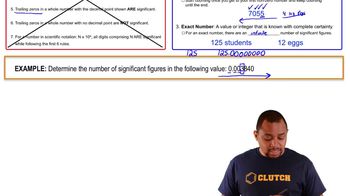
Significant Figures

Significant figures are the digits in a number that contribute to its precision. This includes all non-zero digits, any zeros between significant digits, and trailing zeros in the decimal portion. Understanding significant figures is crucial for accurately reporting measurements and calculations in chemistry, as it reflects the precision of the data.
Video consigliato:
Percorso guidato
01:09
Significant Figures Example

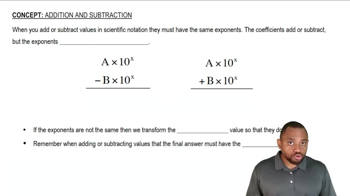
Rules for Addition and Subtraction

When performing addition or subtraction, the result should be reported with the same number of decimal places as the measurement with the least number of decimal places. This rule ensures that the precision of the result is not overstated, maintaining the integrity of the data derived from the least precise measurement.
Video consigliato:
Percorso guidato
01:47
Scientific Notation in Addition and Substraction

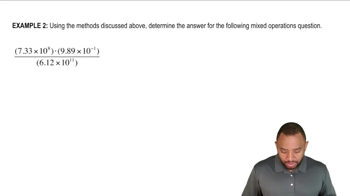
Order of Operations

The order of operations is a set of rules that dictates the sequence in which calculations should be performed to ensure consistent results. In the context of addition and subtraction, operations are typically performed from left to right. This concept is essential for correctly evaluating expressions and ensuring that significant figures are applied appropriately.
Video consigliato:
Percorso guidato
03:10
Scientific Notation Mixed Operations