Ch.1 - Chemical Tools: Experimentation & Measurement
McMurry - Chemistry 8th Edition
McMurry8th EditionChemistryISBN: 9781292336145Non è quello che usi tu?Cambia libro di testo
Capitolo 1, Problema 70

Gaseous hydrogen has a density of 0.0899 g/L at 0 °C, and gaseous chlorine has a density of 3.214 g/L at the same tem-perature. How many liters of each would you need if you wanted 1.0078 g of hydrogen and 35.45 g of chlorine?

Guida verificata passo dopo passo
1
Identify the given densities: hydrogen has a density of 0.0899 g/L and chlorine has a density of 3.214 g/L.
Determine the mass of hydrogen needed: 1.0078 g.
Determine the mass of chlorine needed: 35.45 g.
Use the formula for density, \( \text{Density} = \frac{\text{Mass}}{\text{Volume}} \), to find the volume of hydrogen needed: \( \text{Volume} = \frac{\text{Mass}}{\text{Density}} \).
Use the same formula to find the volume of chlorine needed: \( \text{Volume} = \frac{\text{Mass}}{\text{Density}} \).

Risposta video verificata per un problema simile:

Questa soluzione video è stata consigliata dai nostri tutor come utile per risolvere questo problema.
Durata del video:
3m

Concetti chiave

Ecco i concetti essenziali che devi comprendere per rispondere correttamente alla domanda.

Density

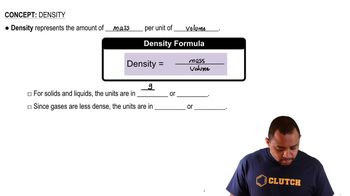
Density is defined as mass per unit volume, typically expressed in grams per liter (g/L) for gases. It is a crucial property that helps determine how much space a given mass of a substance will occupy. In this question, the densities of hydrogen and chlorine are provided, allowing us to calculate the volume needed to obtain specific masses of each gas.
Video consigliato:
Percorso guidato
01:56
Density Concepts

Gas Laws

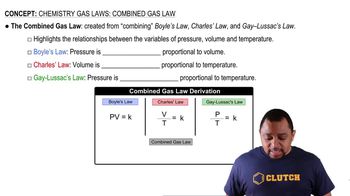
Gas laws describe the behavior of gases in relation to pressure, volume, and temperature. The ideal gas law (PV=nRT) is particularly relevant, as it relates the number of moles of a gas to its volume and density. Understanding these laws helps in calculating the volume of gases required for a given mass, especially under standard conditions.
Video consigliato:
Percorso guidato
01:43
Combined Gas Law

Molar Mass

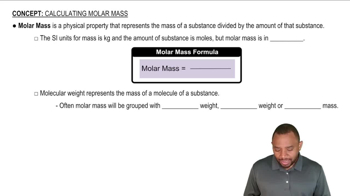
Molar mass is the mass of one mole of a substance, typically expressed in grams per mole (g/mol). It is essential for converting between mass and moles, which is necessary for applying the ideal gas law. In this question, knowing the molar masses of hydrogen (2.016 g/mol) and chlorine (70.906 g/mol) allows for accurate calculations of the volumes needed for the specified masses.
Video consigliato:
Percorso guidato
02:11
Molar Mass Concept