Ch.1 - Chemical Tools: Experimentation & Measurement
McMurry - Chemistry 8th Edition
McMurry8th EditionChemistryISBN: 9781292336145Non è quello che usi tu?Cambia libro di testo
Capitolo 1, Problema 11

Report the reading on the buret to the correct number of significant figures. (LO 1.15) (a) 1 mL (b) 1.4 mL (c) 1.40 mL (d) 1.400 mL

Guida verificata passo dopo passo
1
Understand that the number of significant figures in a measurement reflects the precision of the instrument used.
A buret typically allows for readings to the nearest 0.01 mL, indicating that the measurement should have two decimal places.
Examine each option to determine which one reflects the correct number of significant figures for a buret reading.
Option (a) '1 mL' has only one significant figure, which is not precise enough for a buret.
Option (b) '1.4 mL' has two significant figures, but only one decimal place, which is not precise enough for a buret.

Risposta video verificata per un problema simile:

Questa soluzione video è stata consigliata dai nostri tutor come utile per risolvere questo problema.
Durata del video:
1m

Concetti chiave

Ecco i concetti essenziali che devi comprendere per rispondere correttamente alla domanda.

Significant Figures

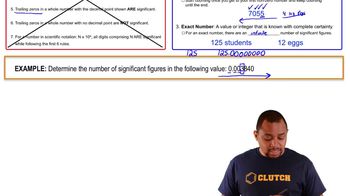
Significant figures are the digits in a number that contribute to its precision. This includes all non-zero digits, any zeros between significant digits, and trailing zeros only when there is a decimal point. Understanding significant figures is crucial for accurately reporting measurements in scientific contexts, as they reflect the precision of the measuring instrument.
Video consigliato:
Percorso guidato
01:09
Significant Figures Example

Measurement Precision

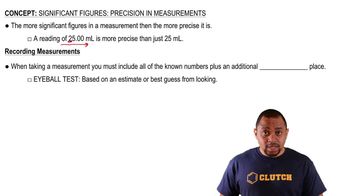
Measurement precision refers to the degree of reproducibility or consistency of a set of measurements. It is influenced by the measuring instrument's capability and the method used. In chemistry, reporting measurements with the correct number of significant figures ensures that the precision of the measurement is communicated effectively, which is vital for experimental accuracy.
Video consigliato:
Percorso guidato
01:49
Significant Figures Precision

Rounding Rules

Rounding rules dictate how to adjust numbers to reflect the correct number of significant figures. When rounding, if the digit to the right of the last significant figure is less than 5, the last significant figure remains unchanged; if it is 5 or greater, the last significant figure is increased by one. Applying these rules correctly is essential for maintaining the integrity of reported measurements.
Video consigliato:
Percorso guidato
00:28
Solubility Rules
Pratica correlata
Domanda del libro di testo
A person runs at a pace of 6.52 mi/hr. How long does it take the person to run a 15.0 km race? (1 mi = 1.61 km) (LO 1.17) (a) 85.7 min (b) 222 min (c) 50.0 min (d) 93.4 min
535
views

Domanda del libro di testo
Perform the calculation, and report the answer to the correct number of significant figures. (LO 1.16) (a) 1.5 * 10^-4 (b) 1.55 * 10^-4 (c) 1.547 * 10^-4 (d) 1.5473 * 10^-4
337
views
Domanda del libro di testo
A scientist uses an uncalibrated pH meter and measures the pH of a rainwater sample four times. A different pH meter was calibrated using several solutions with known pH. The true pH of the rain was found by the calibrated pH meter to be 5.12. What can be said about the level of accuracy and precision of the uncalibrated pH meter? (LO 1.14) (a) The uncalibrated pH meter is accurate and precise. (b) The uncalibrated pH meter is neither accurate nor precise. (c) The uncalibrated pH meter is accurate but not precise. (d) The uncalibrated pH meter is precise but not accurate.
375
views
Domanda del libro di testo
Consider 20 mL samples of the following liquids. Which sample has the largest mass? (LO 1.9) (a) Water (density = 1.0 g/mL) (b) Glycerol (density = 1.26 g/mL) (c) Ethanol (density = 0.79 g/mL) (d) Acetic acid (density = 1.05 g/mL
668
views
Domanda del libro di testo
The cylinder contains two liquids that do not mix with one another: water (density = 1.0 g/mL) and vegetable oil (density = 0.93 g/mL). Four different pieces of plastic are added to the cylinder. Which type of plastic is at the position indicated by the square object in the figure? (LO 1.10) (a) Polyvinyl chloride (density = 1.26 g/mL) (b) Polypropylene (density = 0.90 g/mL) (c) High-density polyethylene (density = 0.96 g/mL) (d) Polyethylene terephthalate (density = 1.38 g/mL)

518
views
Domanda del libro di testo

An electron with a mass of 9.1 * 10-28 g is traveling at 1.8 * 107 m/s in an electron microscope. Calculate the kinetic energy of electron in units of joules, and report your answer in scientific notation. (LO 1.11) (a) 1.5 * 10-16 J (b) 1.6 * 10-20 J (c) 2.9 * 10-13 J (d) 2.9 * 10-10 J

641
views