What is the density of glass in g/cm3 if a sample weighing 27.43 g has a volume of 12.40 cm3?
Guida verificata passo dopo passo
1
Identify the given mass of the glass sample, which is 27.43 grams.
Identify the given volume of the glass sample, which is 12.40 cm^3.
Recall the formula for density, which is \( \text{Density} = \frac{\text{Mass}}{\text{Volume}} \).
Substitute the given values into the density formula: \( \text{Density} = \frac{27.43 \, \text{g}}{12.40 \, \text{cm}^3} \).
Calculate the density using the substituted values to find the density in grams per cubic centimeter (g/cm^3).
Risposta video verificata per un problema simile:
Questa soluzione video è stata consigliata dai nostri tutor come utile per risolvere questo problema.
Durata del video:
1m
Guarda un video:
0 Commenti
Concetti chiave
Ecco i concetti essenziali che devi comprendere per rispondere correttamente alla domanda.
Density
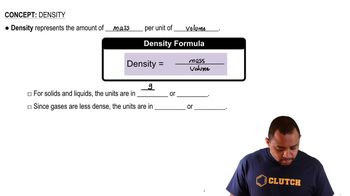
Density is defined as the mass of an object divided by its volume, typically expressed in grams per cubic centimeter (g/cm³) for solids and liquids. It is a physical property that helps identify substances and can be calculated using the formula: Density = Mass/Volume. Understanding density is crucial for solving problems related to the mass and volume of materials.
Mass is a measure of the amount of matter in an object, usually measured in grams (g), while volume is the amount of space that an object occupies, measured in cubic centimeters (cm³) or liters (L). In the context of the question, knowing both the mass of the glass sample and its volume is essential to calculate its density accurately.
In chemistry, it is important to use consistent units of measurement to ensure accurate calculations. The question uses grams for mass and cubic centimeters for volume, which are compatible units for calculating density. Understanding how to convert between different units, if necessary, is also vital for solving problems in chemistry.

 McMurry 8th Edition
 Guida verificata passo dopo passo
 01:56
01:56