Ch.1 - Chemical Tools: Experimentation & Measurement
McMurry - Chemistry 8th Edition
McMurry8th EditionChemistryISBN: 9781292336145Non è quello che usi tu?Cambia libro di testo
Capitolo 1, Problema 109

When an irregularly shaped chunk of silicon weighing 8.763 g was placed in a graduated cylinder containing 25.00 mL of water, the water level in the cylinder rose to 28.76 mL. What is the density of silicon in g/cm3?

Guida verificata passo dopo passo
1
Calculate the volume of the silicon chunk by subtracting the initial water volume from the final water volume. Use the formula: \( V_{\text{silicon}} = V_{\text{final}} - V_{\text{initial}} \).
Convert the volume of the silicon from milliliters to cubic centimeters (cm3), noting that 1 mL is equivalent to 1 cm3.
Use the mass of the silicon chunk given in the problem.
Calculate the density of the silicon using the formula: \( \text{Density} = \frac{\text{Mass}}{\text{Volume}} \).
Express the density in grams per cubic centimeter (g/cm3).

Risposta video verificata per un problema simile:

Questa soluzione video è stata consigliata dai nostri tutor come utile per risolvere questo problema.
Durata del video:
1m

Concetti chiave

Ecco i concetti essenziali che devi comprendere per rispondere correttamente alla domanda.

Density

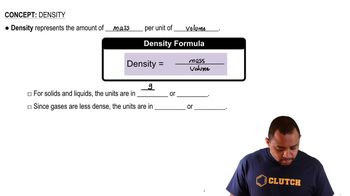
Density is defined as the mass of an object divided by its volume, typically expressed in grams per cubic centimeter (g/cm³). It is a physical property that helps identify substances and can be calculated using the formula: density = mass/volume. In this question, the density of silicon can be determined by measuring the mass of the silicon chunk and the volume of water it displaces.
Video consigliato:
Percorso guidato
01:56
Density Concepts

Volume Displacement

Volume displacement is a method used to measure the volume of an irregularly shaped object by observing the change in liquid level when the object is submerged. According to Archimedes' principle, the volume of water displaced by the object is equal to the volume of the object itself. In this case, the increase in water level from 25.00 mL to 28.76 mL indicates the volume of the silicon chunk.
Video consigliato:
Percorso guidato
02:35
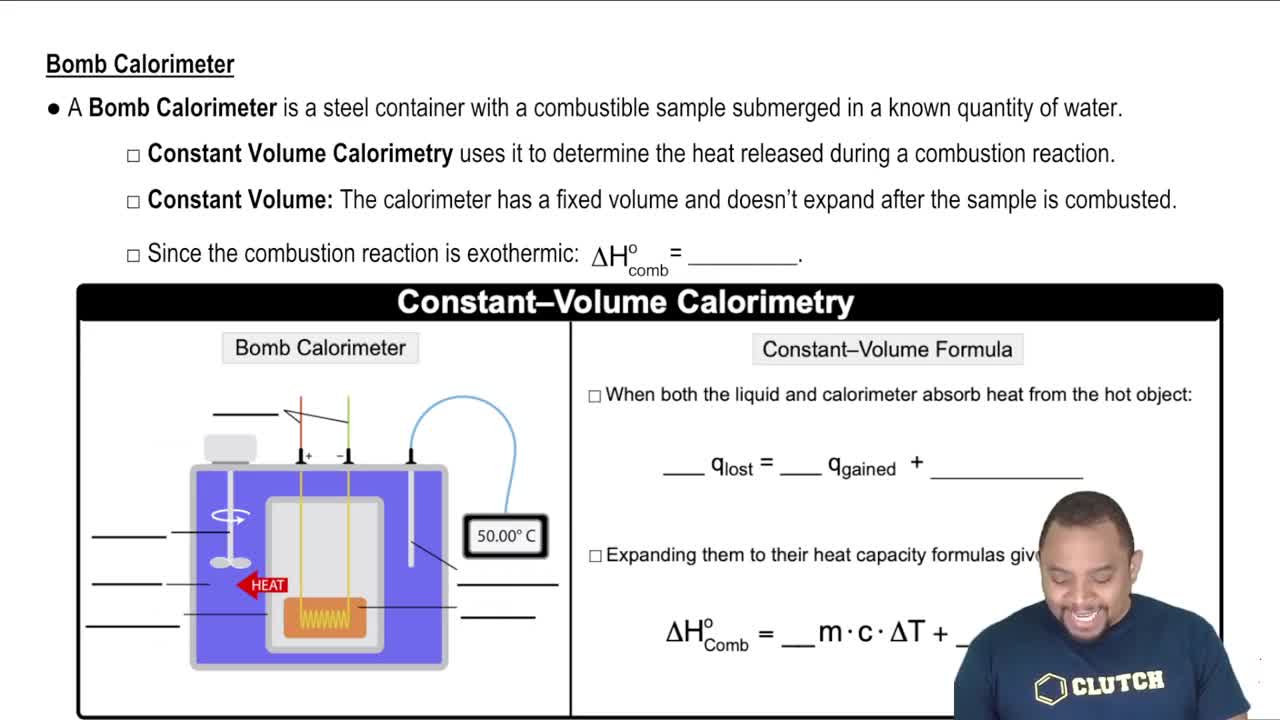
Constant-Volume Calorimetry

Measurement Units

Understanding measurement units is crucial in chemistry, as it ensures accurate calculations and conversions. In this problem, mass is measured in grams (g) and volume in milliliters (mL), which can be directly converted to cubic centimeters (cm³) since 1 mL is equivalent to 1 cm³. This knowledge is essential for calculating density correctly, as both mass and volume must be in compatible units.
Video consigliato:
Percorso guidato
02:52
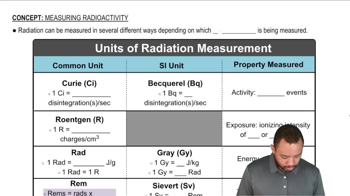
Units of Radiation Measurement