
Ch.10 - Gases: Their Properties & Behavior
McMurry - Chemistry 8th Edition
McMurry8th EditionChemistryISBN: 9781292336145Non è quello che usi tu?Cambia libro di testo
Capitolo 10, Problema 143b

A steel container with a volume of 500.0 mL is evacuated, and 25.0 g of CaCO3 is added. The container and contents are then heated to 1500 K, causing the CaCO3 to decompose completely, according to the equation CaCO3(s) → CaO(s) + CO2(g). (b) Now make a more accurate calculation of the pressure inside the container. Take into account the volume of solid CaO (density = 3.34 g/mL) in the container, and use the van der Waals equation to calculate the pressure. The van der Waals constants for CO2(g) are a = 3.59 (L2-atm)/mol2 and b = 0.0427 L/mol.

Guida verificata passo dopo passo
1
Calculate the number of moles of CaCO3 that decomposed. Use the molar mass of CaCO3 (100.09 g/mol) to convert the mass of CaCO3 to moles.
Determine the volume occupied by the solid CaO produced. Use the mass of CaO formed (equal to the mass of CaCO3 decomposed, assuming complete decomposition) and the density of CaO (3.34 g/mL) to calculate the volume.
Subtract the volume occupied by CaO from the total volume of the container to find the volume available for the CO2 gas.
Use the ideal gas law initially to estimate the number of moles of CO2 produced, assuming the decomposition reaction produces 1 mole of CO2 for every mole of CaCO3 decomposed.
Apply the van der Waals equation, P = \(\frac{nRT}{V-nb}\) - \(\frac{an^2}{V^2}\), where P is the pressure, n is the number of moles of CO2, R is the gas constant (0.0821 L-atm/K-mol), T is the temperature (1500 K), V is the volume available for the gas, a and b are the van der Waals constants for CO2 (3.59 (L2-atm)/mol2 and 0.0427 L/mol respectively).

Risposta video verificata per un problema simile:

Questa soluzione video è stata consigliata dai nostri tutor come utile per risolvere questo problema.
Durata del video:
8m

Concetti chiave

Ecco i concetti essenziali che devi comprendere per rispondere correttamente alla domanda.

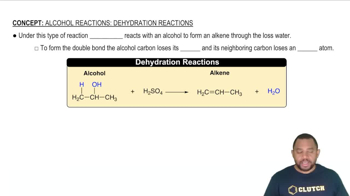
Decomposition Reaction

A decomposition reaction is a type of chemical reaction where a single compound breaks down into two or more simpler products. In this case, calcium carbonate (CaCO3) decomposes into calcium oxide (CaO) and carbon dioxide (CO2) when heated. Understanding this reaction is crucial for determining the amount of gas produced, which directly affects the pressure in the container.
Video consigliato:
Percorso guidato
01:30
Alcohol Reactions: Dehydration Reactions

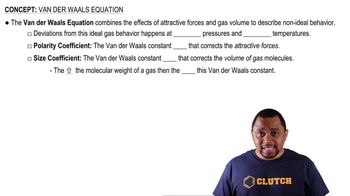
Ideal Gas Law and van der Waals Equation

The Ideal Gas Law (PV=nRT) describes the relationship between pressure (P), volume (V), temperature (T), and the number of moles (n) of a gas. However, real gases deviate from this behavior under high pressure or low temperature, necessitating the use of the van der Waals equation. This equation accounts for the volume occupied by gas particles and the intermolecular forces, providing a more accurate calculation of pressure in non-ideal conditions.
Video consigliato:
Percorso guidato
01:40
Van der Waals Equation

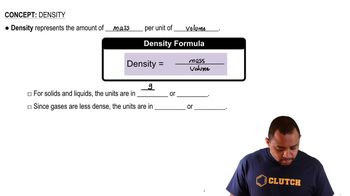
Density and Volume Calculations

Density is defined as mass per unit volume and is essential for calculating the volume occupied by solids in a mixture. In this scenario, the density of solid CaO is given, allowing us to determine its volume in the container. This volume must be subtracted from the total volume of the container to find the effective volume available for the gas, which is critical for accurate pressure calculations using the van der Waals equation.
Video consigliato:
Percorso guidato
01:56
Density Concepts
Pratica correlata
Domanda del libro di testo

When 10.0 g of a mixture of Ca(ClO3)2 and Ca(ClO)2 is heated to 700 °C in a 10.0-L vessel, both compounds decompose, forming O2(g) and CaCl2(s). The final pressure inside the vessel is 1.00 atm. (a) Write balanced equations for the decomposition reactions.

328
views
Domanda del libro di testo

An empty 4.00-L steel vessel is filled with 1.00 atm of CH4(g) and 4.00 atm of O2(g) at 300 °C. A spark causes the CH4 to burn completely, according to the equation

CH4(g) + 2 O2(g) → CO2(g) + 2 H2O(g) ΔH° = -802 kJ

(b) What is the final temperature inside the vessel after combustion, assuming that the steel vessel has a mass of 14.500 kg, the mixture of gases has an average molar heat capacity of 21 J/(mol·°C), and the heat capacity of steel is 0.449 J/(g·°C)?

685
views
Domanda del libro di testo
A 5.00-L vessel contains 25.0 g of PCl3 and 3.00 g of O2 at 15 °C. The vessel is heated to 200.0 °C, and the contents react to give POCl3. What is the final pressure in the vessel, assuming that the reaction goes to completion and that all reactants and products are in the gas phase?
750
views
Domanda del libro di testo

A steel container with a volume of 500.0 mL is evacuated, and 25.0 g of CaCO3 is added. The container and contents are then heated to 1500 K, causing the CaCO3 to decompose completely, according to the equation CaCO3(s) → CaO(s) + CO2(g). (a) Using the ideal gas law and ignoring the volume of any solids remaining in the container, calculate the pressure inside the container at 1500 K.

433
views
Domanda del libro di testo

An empty 4.00-L steel vessel is filled with 1.00 atm of CH4(g) and 4.00 atm of O2(g) at 300 °C. A spark causes the CH4 to burn completely, according to the equation

CH4(g) + 2 O2(g) → CO2(g) + 2 H2O(g) ΔH° = -802 kJ

(a) What mass of CO2(g) is produced in the reaction?

575
views