

Ch.10 - Gases: Their Properties & Behavior
McMurry - Chemistry 8th Edition
McMurry8th EditionChemistryISBN: 9781292336145Non è quello che usi tu?Cambia libro di testo
Capitolo 10, Problema 76

A typical high-pressure tire on a bicycle might have a volume of 365 mL and a pressure of 7.80 atm at 25 °C. Suppose the rider filled the tire with helium to minimize weight. What is the mass of the helium in the tire?

Guida verificata passo dopo passo
1
Convert the volume from milliliters to liters by dividing by 1000, since 1 L = 1000 mL.
Use the ideal gas law equation, \( PV = nRT \), to solve for the number of moles \( n \) of helium. Here, \( P \) is the pressure in atm, \( V \) is the volume in liters, \( R \) is the ideal gas constant (0.0821 L·atm/mol·K), and \( T \) is the temperature in Kelvin.
Convert the temperature from Celsius to Kelvin by adding 273.15 to the Celsius temperature.
Rearrange the ideal gas law equation to solve for \( n \): \( n = \frac{PV}{RT} \). Substitute the known values for \( P \), \( V \), \( R \), and \( T \) into the equation to find \( n \).
Calculate the mass of helium by multiplying the number of moles \( n \) by the molar mass of helium (4.00 g/mol).

Risposta video verificata per un problema simile:

Questa soluzione video è stata consigliata dai nostri tutor come utile per risolvere questo problema.
Durata del video:
7m

Concetti chiave

Ecco i concetti essenziali che devi comprendere per rispondere correttamente alla domanda.

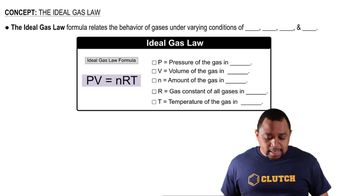
Ideal Gas Law

The Ideal Gas Law is a fundamental equation in chemistry that relates the pressure, volume, temperature, and number of moles of a gas. It is expressed as PV = nRT, where P is pressure, V is volume, n is the number of moles, R is the ideal gas constant, and T is temperature in Kelvin. This law allows us to calculate the amount of gas in a given volume and conditions, which is essential for determining the mass of helium in the tire.
Video consigliato:
Percorso guidato
01:15
Ideal Gas Law Formula

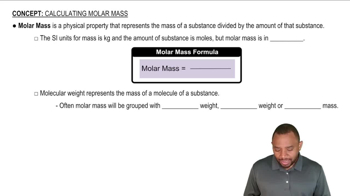
Molar Mass

Molar mass is the mass of one mole of a substance, typically expressed in grams per mole (g/mol). For helium, the molar mass is approximately 4.00 g/mol. Understanding molar mass is crucial for converting between the number of moles of gas and its mass, enabling us to find the total mass of helium in the tire once we calculate the number of moles using the Ideal Gas Law.
Video consigliato:
Percorso guidato
02:11
Molar Mass Concept

Gas Behavior at Different Conditions

Gases behave differently under varying conditions of pressure and temperature. At high pressures, gases can deviate from ideal behavior, but for many practical calculations, the Ideal Gas Law provides a good approximation. In this scenario, understanding how helium behaves at 7.80 atm and 25 °C is important for accurately determining its mass in the tire, as it influences the calculations derived from the Ideal Gas Law.
Video consigliato:
Percorso guidato
02:13
Ideal Gas Conditions Example
Pratica correlata