Ch.10 - Gases: Their Properties & Behavior
McMurry - Chemistry 8th Edition
McMurry8th EditionChemistryISBN: 9781292336145Non è quello che usi tu?Cambia libro di testo
Capitolo 10, Problema 68

An unknown gas is placed in a 1.500-L bulb at a pressure of 356 mm Hg and a temperature of 22.5 °C and is found to weigh 0.9847 g. What is the molecular weight of the gas?

Guida verificata passo dopo passo
1
Convert the temperature from degrees Celsius to Kelvin by adding 273.15 to the Celsius temperature: \( T(K) = 22.5 + 273.15 \).
Convert the pressure from mm Hg to atm using the conversion factor: 1 atm = 760 mm Hg. Calculate \( P(atm) = \frac{356}{760} \).
Use the Ideal Gas Law equation \( PV = nRT \) to solve for the number of moles \( n \). Rearrange the equation to \( n = \frac{PV}{RT} \), where \( R \) is the ideal gas constant (0.0821 L·atm/mol·K).
Substitute the known values for \( P \), \( V \), \( R \), and \( T \) into the equation to calculate \( n \), the number of moles of the gas.
Calculate the molecular weight (molar mass) of the gas using the formula: \( \text{Molecular Weight} = \frac{\text{mass of gas}}{\text{number of moles}} \). Use the mass of the gas (0.9847 g) and the moles calculated in the previous step.

Concetti chiave

Ecco i concetti essenziali che devi comprendere per rispondere correttamente alla domanda.

Ideal Gas Law

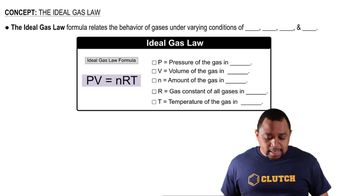
The Ideal Gas Law relates the pressure, volume, temperature, and number of moles of a gas through the equation PV = nRT. This law is essential for understanding the behavior of gases under various conditions and allows for the calculation of the number of moles (n) when the other variables are known.
Video consigliato:
Percorso guidato
01:15
Ideal Gas Law Formula

Molecular Weight

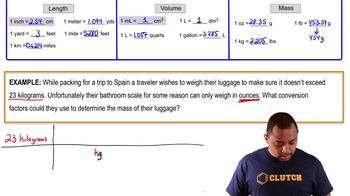
Molecular weight, or molar mass, is the mass of one mole of a substance, typically expressed in grams per mole (g/mol). It can be calculated by dividing the mass of the gas by the number of moles, which can be derived from the Ideal Gas Law. Understanding this concept is crucial for determining the identity of the gas in the question.
Video consigliato:
Percorso guidato
03:45
Weight Conversion Example

Unit Conversion

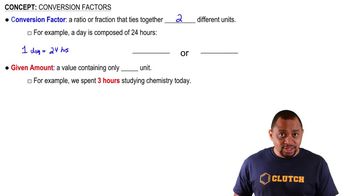
Unit conversion is the process of converting measurements from one unit to another, which is often necessary in chemistry. In this question, pressure is given in mm Hg and needs to be converted to atmospheres (atm) for consistency with the Ideal Gas Law, while temperature must be converted to Kelvin. Mastery of unit conversion is vital for accurate calculations.
Video consigliato:
Percorso guidato
01:56
Conversion Factors