Ch.10 - Gases: Their Properties & Behavior
McMurry - Chemistry 8th Edition
McMurry8th EditionChemistryISBN: 9781292336145Non è quello che usi tu?Cambia libro di testo
Capitolo 10, Problema 48b

Assume that you have a cylinder with a movable piston. What would happen to the gas pressure inside the cylinder if you were to do the following? (b) Reduce the amount of gas by one-third while holding the temperature and volume constant

Guida verificata passo dopo passo
1
Step 1: Understand the problem. We are asked to determine the effect on the gas pressure inside a cylinder if the amount of gas is reduced by one-third while the temperature and volume are held constant.
Step 2: Recall the ideal gas law, which states that the pressure of a gas is directly proportional to the number of moles of gas (n) and the temperature (T), and inversely proportional to the volume (V). It is expressed as P = nRT/V, where R is the ideal gas constant.
Step 3: Since the temperature and volume are held constant in this scenario, we can simplify the ideal gas law to P ∝ n. This means that the pressure is directly proportional to the number of moles of gas.
Step 4: If the amount of gas is reduced by one-third, this means that the number of moles of gas (n) is reduced by one-third. Because pressure is directly proportional to the number of moles, the pressure will also decrease.
Step 5: Therefore, if the amount of gas is reduced by one-third while the temperature and volume are held constant, the gas pressure inside the cylinder will decrease by one-third.

Risposta video verificata per un problema simile:

Questa soluzione video è stata consigliata dai nostri tutor come utile per risolvere questo problema.
Durata del video:
2m

Concetti chiave

Ecco i concetti essenziali che devi comprendere per rispondere correttamente alla domanda.

Ideal Gas Law

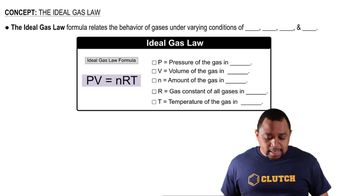
The Ideal Gas Law relates the pressure, volume, temperature, and amount of gas in a system through the equation PV = nRT. In this equation, P represents pressure, V is volume, n is the number of moles of gas, R is the ideal gas constant, and T is temperature. Understanding this relationship is crucial for predicting how changes in the amount of gas affect pressure when other variables are held constant.
Video consigliato:
Percorso guidato
01:15
Ideal Gas Law Formula

Gas Pressure

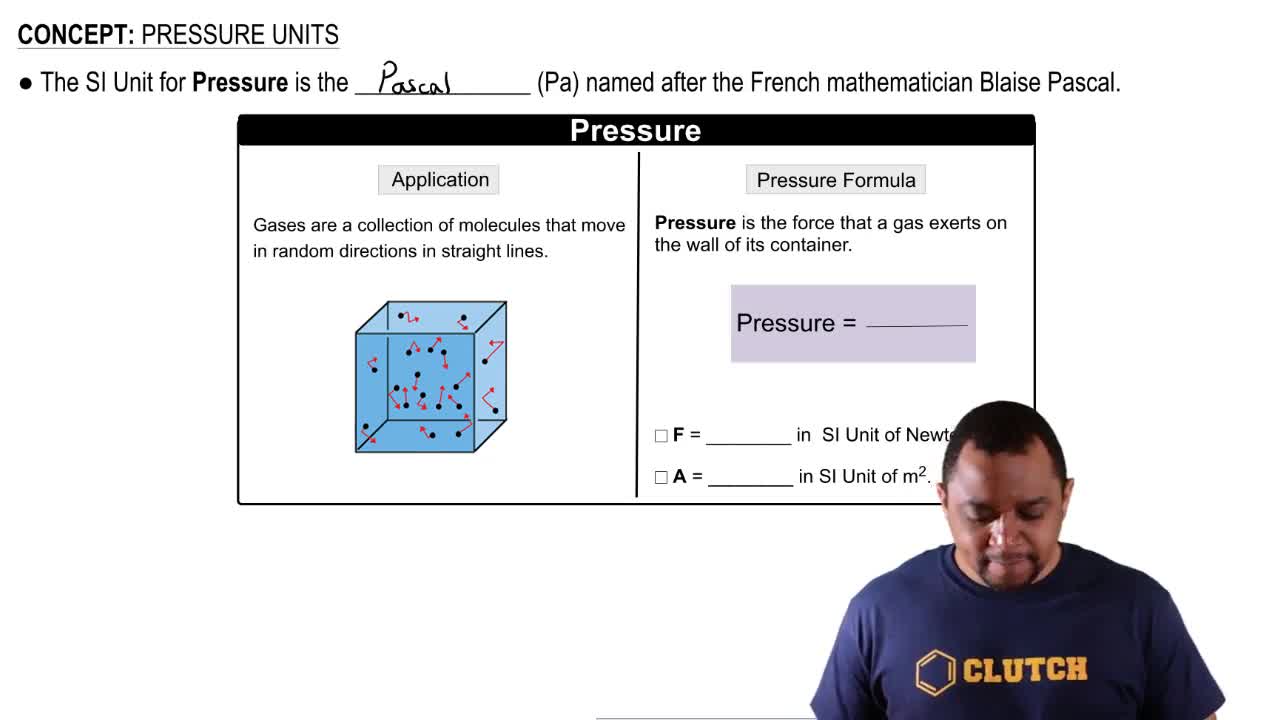
Gas pressure is defined as the force exerted by gas molecules colliding with the walls of their container. It is influenced by the number of gas particles, their temperature, and the volume of the container. When the amount of gas is reduced while keeping temperature and volume constant, the frequency of collisions decreases, leading to a decrease in pressure.
Video consigliato:

Avogadro's Principle

Avogadro's Principle states that equal volumes of gases, at the same temperature and pressure, contain an equal number of molecules. This principle implies that if the amount of gas is reduced, the number of gas molecules decreases, which directly affects the pressure in a closed system. In this scenario, reducing the gas by one-third will result in a proportional decrease in pressure.
Video consigliato:
Percorso guidato
02:05
Uncertainty Principle Formula