Ch.10 - Gases: Their Properties & Behavior
McMurry - Chemistry 8th Edition
McMurry8th EditionChemistryISBN: 9781292336145Non è quello che usi tu?Cambia libro di testo
Capitolo 10, Problema 49b

Assume that you have a cylinder with a movable piston. What would happen to the gas volume of the cylinder if you were to do the following? (b) Increase the amount of gas by one-fourth while holding the temperature and pressure constant

Guida verificata passo dopo passo
1
Step 1: Understand the problem. The problem is asking what would happen to the volume of gas in a cylinder if the amount of gas is increased by one-fourth while the temperature and pressure are held constant. This is a question about the ideal gas law, which states that the pressure of a gas times its volume is equal to the number of moles of the gas times the gas constant times the temperature (PV = nRT).
Step 2: Identify the variables in the ideal gas law that are held constant. In this case, the problem states that the temperature (T) and pressure (P) are held constant.
Step 3: Consider the effect of increasing the amount of gas (n) by one-fourth. According to the ideal gas law, if the pressure and temperature are held constant, then an increase in the amount of gas should result in a proportional increase in the volume of the gas.
Step 4: Calculate the new volume. Since the amount of gas is increased by one-fourth, the volume of the gas should also increase by one-fourth. This is because the volume is directly proportional to the number of moles of gas when the pressure and temperature are held constant.
Step 5: Conclude that the volume of the gas in the cylinder would increase by one-fourth if the amount of gas is increased by one-fourth while the temperature and pressure are held constant.

Risposta video verificata per un problema simile:

Questa soluzione video è stata consigliata dai nostri tutor come utile per risolvere questo problema.
Durata del video:
4m

Concetti chiave

Ecco i concetti essenziali che devi comprendere per rispondere correttamente alla domanda.

Ideal Gas Law

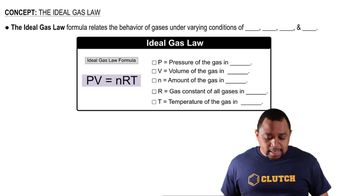
The Ideal Gas Law relates the pressure, volume, temperature, and amount of gas in a system through the equation PV = nRT. In this context, 'n' represents the number of moles of gas, 'R' is the ideal gas constant, and 'T' is the temperature in Kelvin. Understanding this law is crucial for predicting how changes in the amount of gas affect its volume when temperature and pressure are held constant.
Video consigliato:
Percorso guidato
01:15
Ideal Gas Law Formula

Avogadro's Principle

Avogadro's Principle states that equal volumes of gases, at the same temperature and pressure, contain an equal number of molecules. This principle implies that if the amount of gas in a cylinder is increased by one-fourth while keeping temperature and pressure constant, the volume of the gas must also increase proportionally to accommodate the additional gas molecules.
Video consigliato:
Percorso guidato
02:05
Uncertainty Principle Formula

Charles's Law

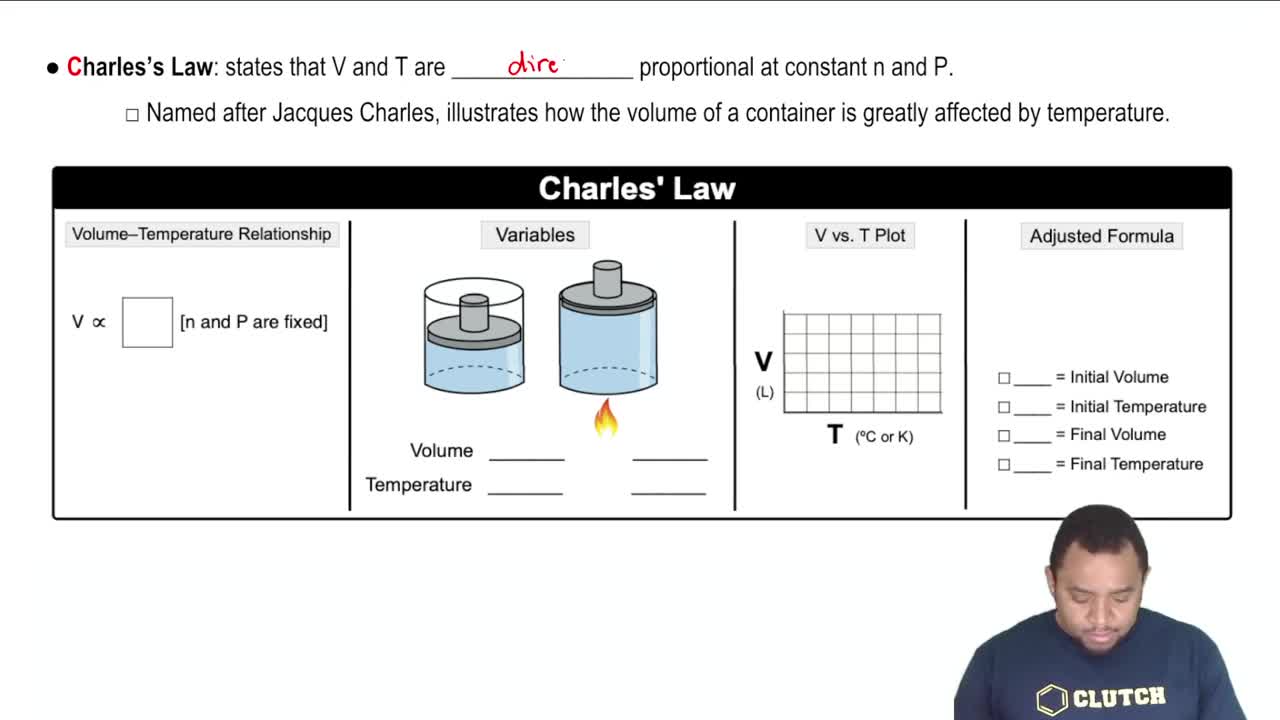
Charles's Law describes how the volume of a gas is directly proportional to its temperature when pressure is held constant. Although this scenario keeps temperature constant, understanding this law helps clarify the relationship between volume and the amount of gas. It reinforces the idea that changes in the quantity of gas will affect its volume under constant conditions.
Video consigliato: