Ch.10 - Gases: Their Properties & Behavior
McMurry - Chemistry 8th Edition
McMurry8th EditionChemistryISBN: 9781292336145Non è quello che usi tu?Cambia libro di testo
Capitolo 10, Problema 105

Chlorine occurs as a mixture of two isotopes, 35Cl and 37Cl. What is the ratio of the diffusion rates of the three species 135Cl22, 35Cl37Cl, and 137Cl22?

Guida verificata passo dopo passo
1
Identify the molar masses of the isotopes and the species involved. The isotopes are 35Cl and 37Cl. The species are 35Cl2, 35Cl37Cl, and 37Cl2.
Calculate the molar mass of each species. For 35Cl2, it is twice the mass of 35Cl. For 35Cl37Cl, it is the sum of the masses of 35Cl and 37Cl. For 37Cl2, it is twice the mass of 37Cl.
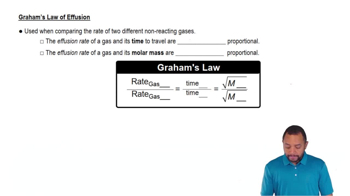
Use Graham's Law of Effusion, which states that the rate of effusion of a gas is inversely proportional to the square root of its molar mass. The formula is Rate1/Rate2 = sqrt(M2/M1), where M1 and M2 are the molar masses of the gases.
Apply Graham's Law to find the ratio of the diffusion rates for each pair of species. Calculate the ratio for 35Cl2 to 35Cl37Cl, 35Cl2 to 37Cl2, and 35Cl37Cl to 37Cl2.
Combine the individual ratios to express the overall ratio of the diffusion rates of 35Cl2, 35Cl37Cl, and 37Cl2.

Risposta video verificata per un problema simile:

Questa soluzione video è stata consigliata dai nostri tutor come utile per risolvere questo problema.
Durata del video:
5m

Concetti chiave

Ecco i concetti essenziali che devi comprendere per rispondere correttamente alla domanda.

Isotopes

Isotopes are variants of a chemical element that have the same number of protons but different numbers of neutrons, resulting in different atomic masses. For chlorine, the isotopes 35Cl and 37Cl differ in mass, which affects their physical properties, including diffusion rates. Understanding isotopes is crucial for analyzing how they behave in various chemical processes.
Video consigliato:

Graham's Law of Effusion

Graham's Law states that the rate of effusion or diffusion of a gas is inversely proportional to the square root of its molar mass. This principle allows us to compare the diffusion rates of different isotopes by calculating the ratio of their rates based on their respective molar masses. It is essential for predicting how quickly different isotopes will diffuse in a mixture.
Video consigliato:
Percorso guidato
2:03
Graham's Law of Effusion

Molar Mass

Molar mass is the mass of one mole of a substance, typically expressed in grams per mole (g/mol). For isotopes, the molar mass is determined by the total number of protons and neutrons in the nucleus. In the context of diffusion, knowing the molar masses of the isotopes involved is necessary to apply Graham's Law and calculate the diffusion rate ratios accurately.
Video consigliato:
Percorso guidato
02:11
Molar Mass Concept