
Ch.10 - Gases: Their Properties & Behavior
McMurry - Chemistry 8th Edition
McMurry8th EditionChemistryISBN: 9781292336145Non è quello che usi tu?Cambia libro di testo
Capitolo 10, Problema 150a

Combustion analysis of 0.1500 g of methyl tert-butyl ether, an octane booster used in gasoline, gave 0.3744 g of CO2 and 0.1838 g of H2O. When a flask having a volume of 1.00 L was evacuated and then filled with methyl tertbutyl ether vapor at a pressure of 100.0 kPa and a temperature of 54.8 °C, the mass of the flask increased by 3.233 g. (a) What is the empirical formula of methyl tert-butyl ether?

Guida verificata passo dopo passo
1
Calculate the moles of CO_2 produced using its mass and molar mass: \( n_{CO_2} = \frac{0.3744 \text{ g}}{44.01 \text{ g/mol}} \).
Calculate the moles of H_2O produced using its mass and molar mass: \( n_{H_2O} = \frac{0.1838 \text{ g}}{18.02 \text{ g/mol}} \).
Determine the moles of carbon in the sample from the moles of CO_2: each mole of CO_2 contains one mole of carbon.
Determine the moles of hydrogen in the sample from the moles of H_2O: each mole of H_2O contains two moles of hydrogen.
Assume the rest of the mass is oxygen, calculate the mass of oxygen in the sample, and then determine the moles of oxygen. Use these moles to find the simplest whole number ratio of C:H:O to determine the empirical formula.

Risposta video verificata per un problema simile:

Questa soluzione video è stata consigliata dai nostri tutor come utile per risolvere questo problema.
Durata del video:
4m

Concetti chiave

Ecco i concetti essenziali che devi comprendere per rispondere correttamente alla domanda.

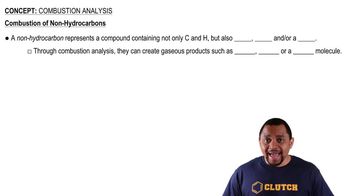
Combustion Analysis

Combustion analysis is a technique used to determine the composition of organic compounds by burning them in excess oxygen and measuring the amounts of produced carbon dioxide (CO2) and water (H2O). The masses of these products are used to calculate the moles of carbon and hydrogen in the original compound, which are essential for deriving the empirical formula.
Video consigliato:
Percorso guidato
01:29
Combustion of Non-Hydrocarbons

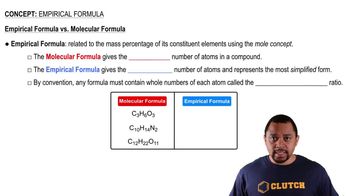
Empirical Formula

The empirical formula of a compound represents the simplest whole-number ratio of the elements present in that compound. It is derived from the mole ratios of the constituent elements, which can be calculated from the results of combustion analysis. This formula provides insight into the basic composition of the substance without indicating the actual number of atoms in a molecule.
Video consigliato:
Percorso guidato
02:26
Empirical vs Molecular Formula

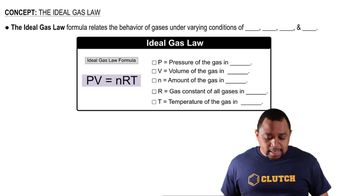
Ideal Gas Law

The Ideal Gas Law relates the pressure, volume, temperature, and number of moles of a gas through the equation PV = nRT. This law is crucial for understanding the behavior of gases under various conditions and is used to calculate the number of moles of vapor in the flask, which can help in determining the molecular formula of the compound when combined with mass data.
Video consigliato:
Percorso guidato
01:15
Ideal Gas Law Formula
Pratica correlata
Domanda del libro di testo

Chemical explosions are characterized by the instantaneous release of large quantities of hot gases, which set up a shock wave of enormous pressure (up to 700,000 atm) and velocity (up to 20,000 mi/h). For example, explosion of nitroglycerin (C3H5N3O9) releases four gases, A, B, C, and D:

n C3H5N3O9(l) a A(g) + b B(g) + c C(g) + d D(g)

Assume that the explosion of 1 mol (227 g) of nitroglycerin releases gases with a temperature of 1950 °C and a volume of 1323 L at 1.00 atm pressure.

(e) Write a balanced equation for the explosion of nitroglycerin.

917
views
Domanda del libro di testo
During a certain time period, 4.0 million tons of SO2 were released into the atmosphere and subsequently oxidized to SO3. As explained in the Inquiry, the acid rain produced when the SO3 dissolves in water can damage marble statues: CaCO31s2 + H2SO41aq2S CaSO41aq2 + CO21g2 + H2O1l2 (b) How many liters of CO2 gas at 20 °C and 735 mm Hg is produced as a byproduct?.
348
views
Domanda del libro di testo
Combustion analysis of 0.1500 g of methyl tert-butyl ether, an octane booster used in gasoline, gave 0.3744 g of CO2 and 0.1838 g of H2O. When a flask having a volume of 1.00 L was evacuated and then filled with methyl tertbutyl ether vapor at a pressure of 100.0 kPa and a temperature of 54.8 °C, the mass of the flask increased by 3.233 g. (b) What is the molecular weight and molecular formula of methyl tert-butyl ether?
300
views
Domanda del libro di testo

Chemical explosions are characterized by the instantaneous release of large quantities of hot gases, which set up a shock wave of enormous pressure (up to 700,000 atm) and velocity (up to 20,000 mi/h). For example, explosion of nitroglycerin (C3H5N3O9) releases four gases, A, B, C, and D:

n C3H5N3O9(l) a A(g) + b B(g) + c C(g) + d D(g)

Assume that the explosion of 1 mol (227 g) of nitroglycerin releases gases with a temperature of 1950 °C and a volume of 1323 L at 1.00 atm pressure.

(d) When gases C and D were passed through a hot tube of powdered copper, gas C reacted to form CuO. The remaining gas, D, was collected in a third 500.0-mL flask and found to have a mass of 0.168 g and a pressure of 223 mm Hg at 25 °C. How many moles each of C and D were present, and what are their likely identities?

603
views
Domanda del libro di testo

Combustion analysis of 0.1500 g of methyl tert-butyl ether, an octane booster used in gasoline, gave 0.3744 g of CO2 and 0.1838 g of H2O. When a flask having a volume of 1.00 L was evacuated and then filled with methyl tertbutyl ether vapor at a pressure of 100.0 kPa and a temperature of 54.8 °C, the mass of the flask increased by 3.233 g. (c) Write a balanced equation for the combustion reaction.

304
views