

Ch.10 - Gases: Their Properties & Behavior
McMurry - Chemistry 8th Edition
McMurry8th EditionChemistryISBN: 9781292336145Non è quello che usi tu?Cambia libro di testo
Capitolo 10, Problema 5

Propane gas 1C3H82 is often used as fuel in rural areas. How many liters of CO2 are formed at STP by the complete combustion of the propane in a container with a volume of 15.0 L and a pressure of 4.50 atm at 25.0 °C? The equation for the combustion of propane is: C3H81g2 + 5 O21g2¡3 CO21g2 + 4 H2O1l2 (LO 10.4, 10.5) (a) 61.8 L (b) 186 L (c) 20.6 L (d) 2.21 * 103 L

Guida verificata passo dopo passo
1
Write the balanced chemical equation for the combustion of propane: C3H8(g) + 5 O2(g) → 3 CO2(g) + 4 H2O(l).
Use the ideal gas law (PV = nRT) to calculate the number of moles of propane (n) in the container. Use the given values: P = 4.50 atm, V = 15.0 L, R = 0.0821 L atm/mol K, and T = 298 K (25°C + 273).
From the balanced equation, determine the mole ratio between propane and carbon dioxide. For every 1 mole of propane, 3 moles of CO2 are produced.
Calculate the total moles of CO2 produced by multiplying the moles of propane by the mole ratio from propane to CO2.
Finally, calculate the volume of CO2 produced at STP (Standard Temperature and Pressure, where T = 273 K and P = 1 atm) using the ideal gas law with the moles of CO2 calculated in the previous step.

Risposta video verificata per un problema simile:

Questa soluzione video è stata consigliata dai nostri tutor come utile per risolvere questo problema.
Durata del video:
5m

Concetti chiave

Ecco i concetti essenziali che devi comprendere per rispondere correttamente alla domanda.

Stoichiometry of Combustion Reactions

Stoichiometry involves using balanced chemical equations to determine the relationships between reactants and products. In the combustion of propane (C3H8), the balanced equation shows that one mole of propane reacts with five moles of oxygen to produce three moles of carbon dioxide and four moles of water. Understanding this ratio is essential for calculating the amount of CO2 produced from a given amount of propane.
Video consigliato:
Percorso guidato
02:24
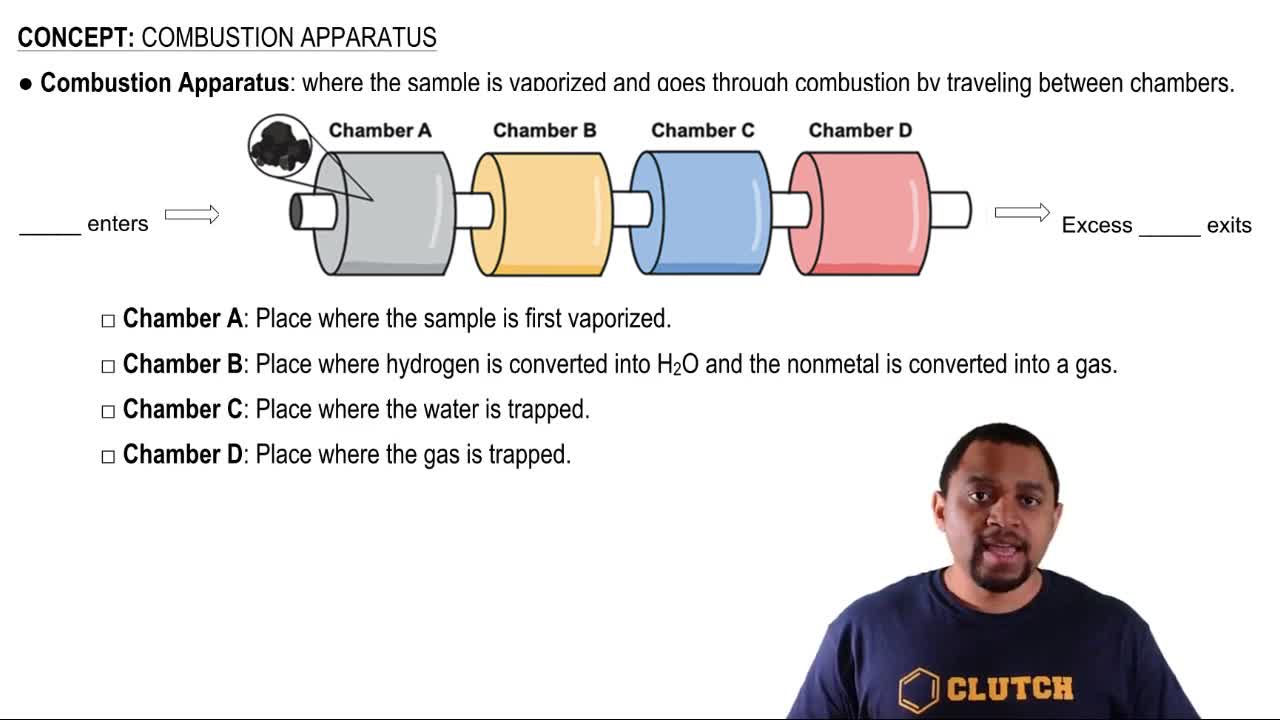
Combustion Apparatus

Ideal Gas Law

The Ideal Gas Law (PV = nRT) relates the pressure, volume, temperature, and number of moles of a gas. At standard temperature and pressure (STP), one mole of an ideal gas occupies 22.4 liters. This law is crucial for converting the number of moles of CO2 produced from the combustion reaction into a volume at STP, allowing for the determination of how many liters of CO2 are formed.
Video consigliato:
Percorso guidato
01:15
Ideal Gas Law Formula

Conditions of STP

Standard Temperature and Pressure (STP) is defined as a temperature of 0 °C (273.15 K) and a pressure of 1 atm. Under these conditions, the behavior of gases can be predicted more accurately. When calculating the volume of gases produced in reactions, it is important to convert the conditions of the reaction (in this case, 25 °C and 4.50 atm) to STP to ensure accurate results.
Video consigliato:
Percorso guidato
02:20
STP Calculation Example