


Two 112-L tanks are filled with gas at 330 K. One contains 5.00 mol of Kr, and the other contains 5.00 mol of O2. Considering the assumptions of kinetic–molecular theory, rank the gases from low to high for each of the following properties. (a) Collision frequency
Ch.10 - Gases: Their Properties & Behavior
Capitolo 10, Problema 109
The reaction NO1g2 + NO21g2 ∆ N2O31g2 takes place in the atmosphere with Kc = 13 at 298 K. A gas mixture is prepared with 2.0 mol NO and 3.0 mol NO2 and an initial total pressure of 1.65 atm. (b) What is the volume of the container?
Guida verificata passo dopo passo1
Determine the total number of moles of gases present initially. Add the moles of NO and NO2 together.
Use the ideal gas law equation, PV = nRT, where P is the pressure, V is the volume, n is the number of moles, R is the gas constant (0.0821 L atm/mol K), and T is the temperature in Kelvin.
Substitute the known values into the ideal gas law equation. Use the total pressure given (1.65 atm) and the temperature (298 K).
Solve the equation for V (volume). Rearrange the ideal gas law equation to isolate V on one side: V = \(\frac{nRT}{P}\).
Calculate the volume by plugging in the values for n, R, T, and P into the rearranged equation.

Risposta video verificata per un problema simile:
Questa soluzione video è stata consigliata dai nostri tutor come utile per risolvere questo problema.
Durata del video:
3mConcetti chiave
Ecco i concetti essenziali che devi comprendere per rispondere correttamente alla domanda.
Equilibrium Constant (Kc)
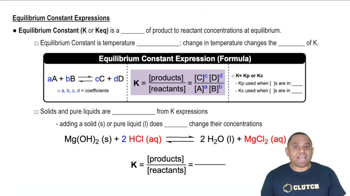
The equilibrium constant (Kc) is a numerical value that expresses the ratio of the concentrations of products to reactants at equilibrium for a given reaction at a specific temperature. In this case, Kc = 13 indicates that at equilibrium, the concentration of N2O3 is significantly favored over the reactants NO and NO2, which is crucial for understanding how the reaction proceeds and how to calculate the changes in concentration.
Video consigliato:
Percorso guidato
Equilibrium Constant Expressions
Ideal Gas Law
The Ideal Gas Law, represented as PV = nRT, relates the pressure (P), volume (V), number of moles (n), the ideal gas constant (R), and temperature (T) of a gas. This law is essential for determining the volume of the container in which the gas mixture is held, as it allows us to calculate volume based on the total number of moles and the pressure of the gas mixture.
Video consigliato:
Percorso guidato
Ideal Gas Law Formula
Stoichiometry
Stoichiometry involves the calculation of reactants and products in chemical reactions based on balanced chemical equations. Understanding stoichiometry is vital for determining the initial concentrations of NO and NO2 in the reaction, which will help in calculating the equilibrium concentrations and ultimately the volume of the container using the Ideal Gas Law.
Video consigliato:
Percorso guidato
Stoichiometry Concept
Pratica correlata
Domanda del libro di testo
362
views
Domanda del libro di testo
Two 112-L tanks are filled with gas at 330 K. One contains 5.00 mol of Kr, and the other contains 5.00 mol of O2. Considering the assumptions of kinetic–molecular theory, rank the gases from low to high for each of the following properties. (d) Pressure
527
views
Domanda del libro di testo
Two 112-L tanks are filled with gas at 330 K. One contains 5.00 mol of Kr, and the other contains 5.00 mol of O2. Considering the assumptions of kinetic–molecular theory, rank the gases from low to high for each of the following properties. (b) Density (g/L)
362
views
