

Ch.10 - Gases: Their Properties & Behavior
McMurry - Chemistry 8th Edition
McMurry8th EditionChemistryISBN: 9781292336145Non è quello che usi tu?Cambia libro di testo
Capitolo 10, Problema 108b

Two 112-L tanks are filled with gas at 330 K. One contains 5.00 mol of Kr, and the other contains 5.00 mol of O2. Considering the assumptions of kinetic–molecular theory, rank the gases from low to high for each of the following properties. (b) Density (g/L)

Guida verificata passo dopo passo
1
Identify the molar masses of the gases involved. Krypton (Kr) has a molar mass of approximately 83.8 g/mol, and Oxygen (O2) has a molar mass of approximately 32.0 g/mol.
Calculate the total mass of each gas in the tanks using the formula: Total mass = Molar mass x Number of moles. For Kr, multiply 83.8 g/mol by 5.00 mol. For O2, multiply 32.0 g/mol by 5.00 mol.
Use the volume of the tanks to calculate the density of each gas. Density = Total mass / Volume. Since each tank has a volume of 112 L, divide the total mass of each gas by 112 L.
Compare the calculated densities of Kr and O2. The gas with the higher total mass per volume will have a higher density.
Rank the gases from low to high density based on the calculated values.

Risposta video verificata per un problema simile:

Questa soluzione video è stata consigliata dai nostri tutor come utile per risolvere questo problema.
Durata del video:
2m

Concetti chiave

Ecco i concetti essenziali che devi comprendere per rispondere correttamente alla domanda.

Kinetic-Molecular Theory

Kinetic-molecular theory explains the behavior of gases in terms of particles in constant motion. It posits that gas particles are far apart, move freely, and collide elastically. This theory helps in understanding properties like pressure, temperature, and volume, which are crucial for analyzing gas behavior in different conditions.
Video consigliato:
Percorso guidato
01:19
Kinetic Molecular Theory

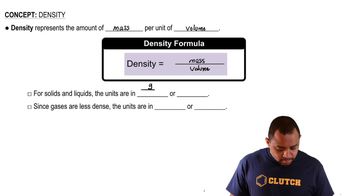
Density of Gases

Density is defined as mass per unit volume. For gases, density can be influenced by temperature and pressure. The ideal gas law (PV=nRT) can be rearranged to find density, showing that at constant temperature and pressure, the density of a gas is directly proportional to its molar mass. Thus, comparing densities of different gases requires knowledge of their molar masses.
Video consigliato:
Percorso guidato
01:56
Density Concepts

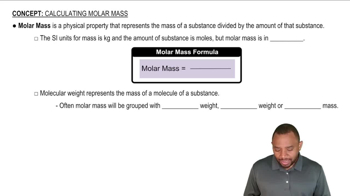
Molar Mass

Molar mass is the mass of one mole of a substance, typically expressed in grams per mole (g/mol). It is a critical factor in determining the density of gases, as heavier gases will generally have higher densities at the same temperature and pressure. For the gases in the question, comparing the molar masses of Kr and O2 will help rank their densities.
Video consigliato:
Percorso guidato
02:11
Molar Mass Concept