

Ch.10 - Gases: Their Properties & Behavior
McMurry - Chemistry 8th Edition
McMurry8th EditionChemistryISBN: 9781292336145Non è quello che usi tu?Cambia libro di testo
Capitolo 10, Problema 141

When 10.0 g of a mixture of Ca1ClO322 and Ca1ClO22 is heated to 700 °C in a 10.0-L vessel, both compounds decompose, forming O21g2 and CaCl21s2. The final pressure inside the vessel is 1.00 atm. (b) What is the mass of each compound in the original mixture?

Guida verificata passo dopo passo
1
Step 1: Write the balanced chemical equations for the decomposition of each compound. For calcium chlorate (Ca(ClO3)2), the decomposition reaction is: Ca(ClO3)2(s) → CaCl2(s) + 3O2(g). For calcium chlorite (Ca(ClO2)2), the decomposition reaction is: Ca(ClO2)2(s) → CaCl2(s) + 2O2(g).
Step 2: Use the ideal gas law to determine the total moles of O2 produced. The ideal gas law is PV = nRT, where P is the pressure, V is the volume, n is the number of moles of gas, R is the gas constant, and T is the temperature in Kelvin.
Step 3: Let x be the moles of Ca(ClO3)2 and y be the moles of Ca(ClO2)2. From the stoichiometry of the reactions, the total moles of O2 produced can be expressed as 3x + 2y. Set up the equation 3x + 2y = total moles of O2 from Step 2.
Step 4: Convert the masses of Ca(ClO3)2 and Ca(ClO2)2 to moles using their molar masses. Set up the equation x * molar mass of Ca(ClO3)2 + y * molar mass of Ca(ClO2)2 = 10.0 g (total mass of the mixture).
Step 5: Solve the system of equations from Step 3 and Step 4 to find the values of x and y. Convert these moles back to grams to find the mass of each compound in the original mixture.

Risposta video verificata per un problema simile:

Questa soluzione video è stata consigliata dai nostri tutor come utile per risolvere questo problema.
Durata del video:
19m

Concetti chiave

Ecco i concetti essenziali che devi comprendere per rispondere correttamente alla domanda.

Stoichiometry

Stoichiometry is the calculation of reactants and products in chemical reactions based on the conservation of mass. It involves using balanced chemical equations to determine the relationships between the amounts of substances consumed and produced. In this question, stoichiometry will help relate the masses of the original compounds to the moles of products formed during decomposition.
Video consigliato:
Percorso guidato
01:16
Stoichiometry Concept

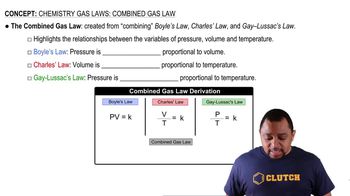
Gas Laws

Gas laws describe the behavior of gases in relation to pressure, volume, and temperature. The ideal gas law (PV=nRT) is particularly relevant here, as it allows us to relate the pressure of the gas produced to the number of moles and the volume of the container. Understanding these relationships is crucial for determining how the decomposition of the compounds affects the final pressure in the vessel.
Video consigliato:
Percorso guidato
01:43
Combined Gas Law

Decomposition Reactions

Decomposition reactions involve a single compound breaking down into two or more simpler products, often requiring heat. In this scenario, both calcium hypochlorite (Ca(ClO)2) and calcium chloride (CaCl2) decompose upon heating, producing oxygen gas and solid calcium chloride. Recognizing the products of these reactions is essential for calculating the mass of each compound in the original mixture.
Video consigliato:
Percorso guidato
01:30
Alcohol Reactions: Dehydration Reactions
Pratica correlata
Domanda del libro di testo

When 10.0 g of a mixture of Ca(ClO3)2 and Ca(ClO)2 is heated to 700 °C in a 10.0-L vessel, both compounds decompose, forming O2(g) and CaCl2(s). The final pressure inside the vessel is 1.00 atm. (a) Write balanced equations for the decomposition reactions.

328
views
Domanda del libro di testo
A mixture of CS21g2 and excess O21g2 is placed in a 10.0-L reaction vessel at 100.0 °C and a pressure of 3.00 atm. A spark causes the CS2 to ignite, burning it completely, according to the equation CS21g2 + 3 O21g2¡CO21g2 + 2 SO21g2 After reaction, the temperature returns to 100.0 °C, and the mixture of product gases (CO2, SO2, and unreacted O2) is found to have a pressure of 2.40 atm. What is the partial pressure of each gas in the product mixture?
416
views
Domanda del libro di testo
When solid mercury(I) carbonate, Hg2CO3, is added to nitric acid, HNO3, a reaction occurs to give mercury(II) nitrate, Hg1NO322, water, and two gases A and B: Hg2CO31s2 + HNO31aq2¡ Hg1NO3221aq2 + H2O1l 2 + A1g2 + B1g2 (a) When the gases are placed in a 500.0-mL bulb at 20 °C, the pressure is 258 mm Hg. How many moles of gas are present?
595
views
Domanda del libro di testo
A 5.00-L vessel contains 25.0 g of PCl3 and 3.00 g of O2 at 15 °C. The vessel is heated to 200.0 °C, and the contents react to give POCl3. What is the final pressure in the vessel, assuming that the reaction goes to completion and that all reactants and products are in the gas phase?
750
views
Domanda del libro di testo

A steel container with a volume of 500.0 mL is evacuated, and 25.0 g of CaCO3 is added. The container and contents are then heated to 1500 K, causing the CaCO3 to decompose completely, according to the equation CaCO3(s) → CaO(s) + CO2(g). (a) Using the ideal gas law and ignoring the volume of any solids remaining in the container, calculate the pressure inside the container at 1500 K.

433
views