Propanol (PrOH) and methyl methacrylate (MMA) asso-ciate in solution by an intermolecular force, forming an adduct represented as PrOH•MMA. The equilibrium con- stant for the association reaction is Kc = 0.701 at 298 K.
(b) Draw a plausible structure for the PrOH • MMA adduct. Use to signify an intermolecular interaction.
Guida verificata passo dopo passo
1
Understand the components involved: Propanol (PrOH) is an alcohol, and methyl methacrylate (MMA) is an ester. Both have functional groups that can participate in intermolecular interactions.
Identify the intermolecular forces: The most likely interaction between PrOH and MMA is hydrogen bonding. The hydroxyl group (OH) in propanol can form a hydrogen bond with the carbonyl oxygen in MMA.
Draw the structure of propanol: CH3CH2CH2OH, where the OH group is the site for hydrogen bonding.
Draw the structure of methyl methacrylate: CH2=C(CH3)COOCH3, where the carbonyl oxygen (C=O) is the site for hydrogen bonding.
Combine the structures: Position the OH group of propanol near the carbonyl oxygen of MMA to represent the hydrogen bond, using a dotted line to signify the intermolecular interaction: PrOH•••MMA.
Risposta video verificata per un problema simile:
Questa soluzione video è stata consigliata dai nostri tutor come utile per risolvere questo problema.
Durata del video:
5m
Guarda un video:
0 Commenti
Concetti chiave
Ecco i concetti essenziali che devi comprendere per rispondere correttamente alla domanda.
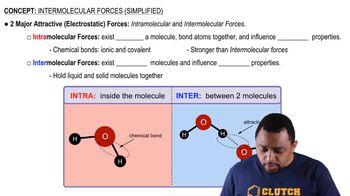
Intermolecular Forces
Intermolecular forces are the attractive forces between molecules that influence physical properties such as boiling and melting points. In the case of the PrOH•MMA adduct, hydrogen bonding is a significant intermolecular force due to the presence of the hydroxyl group in propanol, which can interact with the carbonyl group in methyl methacrylate.
The equilibrium constant (Kc) quantifies the ratio of the concentrations of products to reactants at equilibrium for a reversible reaction. A Kc value of 0.701 indicates that at equilibrium, the concentration of the adduct PrOH•MMA is less than that of the unassociated reactants, suggesting that the association is not highly favored under the given conditions.
Chemical structure representation involves drawing the molecular structure of compounds to illustrate their connectivity and functional groups. For the PrOH•MMA adduct, it is essential to depict the hydrogen bond between the hydroxyl group of propanol and the carbonyl group of methyl methacrylate, using a dotted line to signify the intermolecular interaction.


 Guida verificata passo dopo passo
 01:59
01:59