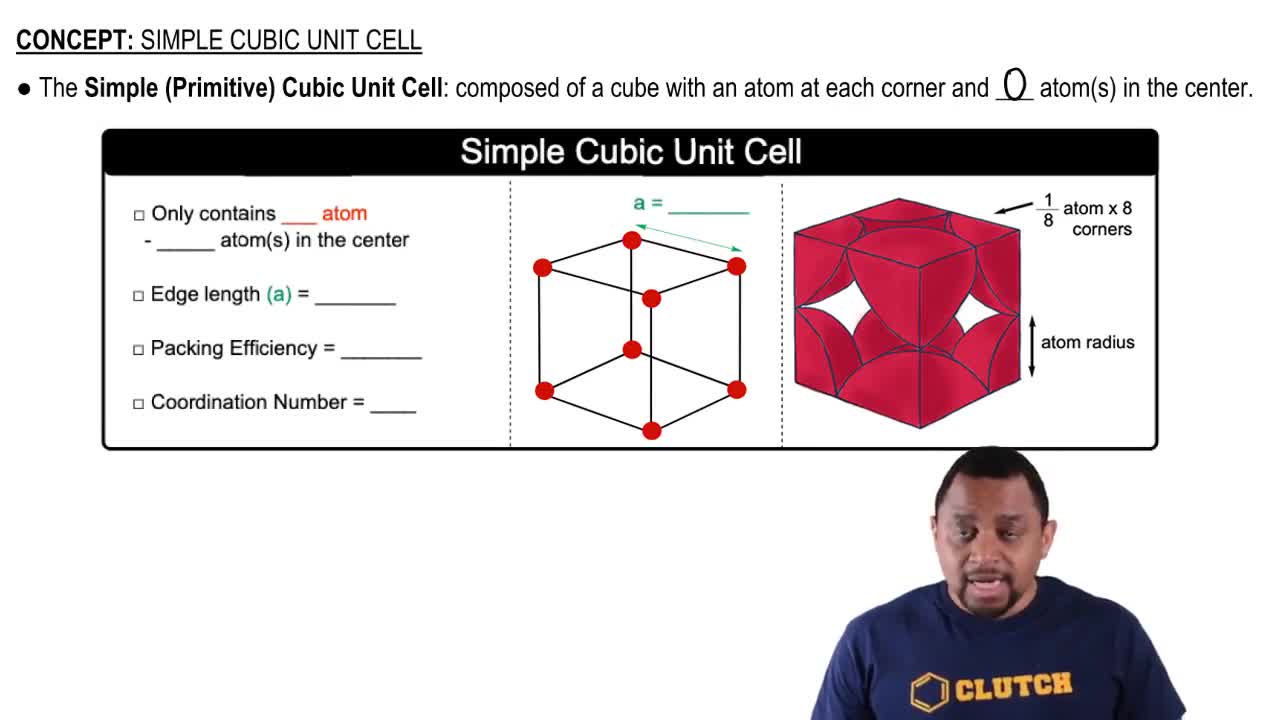
Cesium chloride crystallizes in a cubic unit cell with Cl- ions
at the corners and a Cs+ ion in the center. Count the numbers
of + and - charges, and show that the unit cell is electrically
neutral.
Guida verificata passo dopo passo
1
Identify the positions of the ions in the unit cell: Cl- ions are located at each of the eight corners of the cube, and a single Cs+ ion is located at the center of the cube.
Calculate the contribution of Cl- ions to the unit cell. Since each corner ion is shared by eight adjacent unit cells, each Cl- ion contributes 1/8 of its charge to the unit cell. Multiply the charge contribution of one Cl- ion by the number of corners to find the total charge contributed by Cl- ions.
Consider the contribution of the Cs+ ion. Since the Cs+ ion is located at the center and not shared with any other unit cell, it contributes its entire charge to the unit cell.
Add up the total charges contributed by Cl- ions and the Cs+ ion. Remember that Cl- has a charge of -1 and Cs+ has a charge of +1.
Verify that the sum of the charges equals zero, demonstrating that the unit cell is electrically neutral.
Risposta video verificata per un problema simile:
Questa soluzione video è stata consigliata dai nostri tutor come utile per risolvere questo problema.
Durata del video:
2m
Guarda un video:
0 Commenti
Concetti chiave
Ecco i concetti essenziali che devi comprendere per rispondere correttamente alla domanda.
Ionic Compounds and Charges
Ionic compounds are formed from the electrostatic attraction between positively charged cations and negatively charged anions. In the case of cesium chloride (CsCl), cesium (Cs+) is the cation with a +1 charge, while chloride (Cl-) is the anion with a -1 charge. Understanding the charges of these ions is essential for determining the overall charge balance in the unit cell.
A unit cell is the smallest repeating unit in a crystal lattice that reflects the symmetry and structure of the entire crystal. In the cubic unit cell of cesium chloride, Cl- ions occupy the corners, and a Cs+ ion is located at the center. Recognizing the arrangement of ions within the unit cell is crucial for analyzing the charge distribution and confirming electrical neutrality.
For a crystal to be electrically neutral, the total positive charge must equal the total negative charge. In the CsCl unit cell, there are eight Cl- ions at the corners, each contributing a -1 charge, and one Cs+ ion in the center contributing a +1 charge. By calculating the total charges, one can demonstrate that the unit cell maintains electrical neutrality, as the total charge sums to zero.


 Guida verificata passo dopo passo
 02:11
02:11