
Ch.12 - Solids and Solid-State Materials
McMurry - Chemistry 8th Edition
McMurry8th EditionChemistryISBN: 9781292336145Non è quello che usi tu?Cambia libro di testo
Capitolo 12, Problema 75

Explain why the enthalpy of vaporization of vanadium (460 kJ/mol) is much larger than that of zinc (114 kJ/mol).

Guida verificata passo dopo passo
1
Understand the concept of enthalpy of vaporization, which is the amount of energy required to convert one mole of a substance from the liquid phase to the vapor phase at constant temperature and pressure.
Recognize that vanadium and zinc are both transition metals, but they differ in their electronic configurations and bonding characteristics.
Consider the metallic bonding in vanadium and zinc. Vanadium, with a partially filled d-orbital, can form stronger metallic bonds due to the availability of more electrons for bonding compared to zinc, which has a completely filled d-orbital.
Acknowledge that stronger metallic bonds in vanadium result in a higher enthalpy of vaporization because more energy is required to overcome these bonds during the phase transition from liquid to gas.
Compare the atomic structures and bonding, noting that the stronger the bonding interactions within the metal, the higher the enthalpy of vaporization. This explains why vanadium, with its stronger metallic bonding, has a significantly higher enthalpy of vaporization than zinc.

Risposta video verificata per un problema simile:

Questa soluzione video è stata consigliata dai nostri tutor come utile per risolvere questo problema.
Durata del video:
4m

Concetti chiave

Ecco i concetti essenziali che devi comprendere per rispondere correttamente alla domanda.

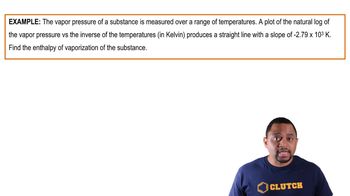
Enthalpy of Vaporization

Enthalpy of vaporization is the amount of energy required to convert a substance from a liquid to a gas at constant temperature and pressure. It reflects the strength of intermolecular forces within the liquid; stronger forces require more energy to overcome. This property is crucial for understanding why different substances have varying vaporization energies.
Video consigliato:
Percorso guidato
01:37
Enthalpy of Vaporization Example

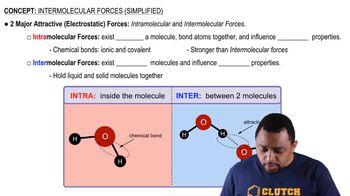
Intermolecular Forces

Intermolecular forces are the attractive forces between molecules that influence physical properties such as boiling and melting points. In metals like vanadium, metallic bonding results in strong interactions between atoms, leading to a higher enthalpy of vaporization compared to zinc, which has weaker metallic bonds and thus lower energy requirements for vaporization.
Video consigliato:
Percorso guidato
01:59
Intermolecular vs Intramolecular Forces

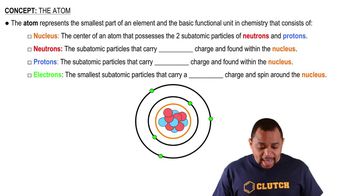
Atomic Structure and Bonding

The atomic structure and bonding of an element determine its physical and chemical properties. Vanadium, being a transition metal with a more complex electron configuration, exhibits stronger bonding characteristics compared to zinc. This difference in bonding strength contributes to the significant disparity in their enthalpy of vaporization values.
Video consigliato: