Ch.12 - Solids and Solid-State Materials
McMurry - Chemistry 8th Edition
McMurry8th EditionChemistryISBN: 9781292336145Non è quello che usi tu?Cambia libro di testo
Capitolo 12, Problema 18d

Identify each of the following kinds of packing: (d)
Diagram of a body centered cubic unit cell with a red sphere at the center and blue spheres at the corners.

Guida verificata passo dopo passo
1
Observe the image provided, which shows a unit cell with a red sphere at the center and blue spheres at the corners.
Identify the type of unit cell based on the arrangement of spheres. The red sphere at the center and blue spheres at the corners indicate a specific type of packing.
Recognize that this arrangement is characteristic of a body-centered cubic (BCC) unit cell.
In a BCC unit cell, there is one atom at each corner of the cube and one atom in the center of the cube.
Conclude that the given image represents a body-centered cubic (BCC) packing.

Risposta video verificata per un problema simile:

Questa soluzione video è stata consigliata dai nostri tutor come utile per risolvere questo problema.
Durata del video:
55s

Concetti chiave

Ecco i concetti essenziali che devi comprendere per rispondere correttamente alla domanda.

Body-Centered Cubic (BCC) Structure

The body-centered cubic (BCC) structure is a type of crystal lattice where one atom is located at each of the eight corners of a cube and a single atom is positioned at the center of the cube. This arrangement results in a coordination number of 8, meaning each central atom is surrounded by eight corner atoms. BCC structures are commonly found in metals like iron and chromium, influencing their physical properties.
Video consigliato:
Percorso guidato
00:40
Body Centered Cubic Example

Coordination Number

The coordination number refers to the number of nearest neighbor atoms surrounding a central atom in a crystal structure. In the case of the BCC structure, the coordination number is 8, indicating that each atom at the center is in contact with eight corner atoms. This concept is crucial for understanding the packing efficiency and stability of different crystal structures.
Video consigliato:
Percorso guidato
00:27
Coordination Numbers

Packing Efficiency

Packing efficiency is a measure of how effectively atoms are packed in a crystal structure, expressed as the ratio of the volume occupied by the atoms to the total volume of the unit cell. In BCC structures, the packing efficiency is approximately 68%, which is lower than that of face-centered cubic (FCC) structures. Understanding packing efficiency helps in predicting the properties of materials, such as density and strength.
Video consigliato:
Percorso guidato
01:41
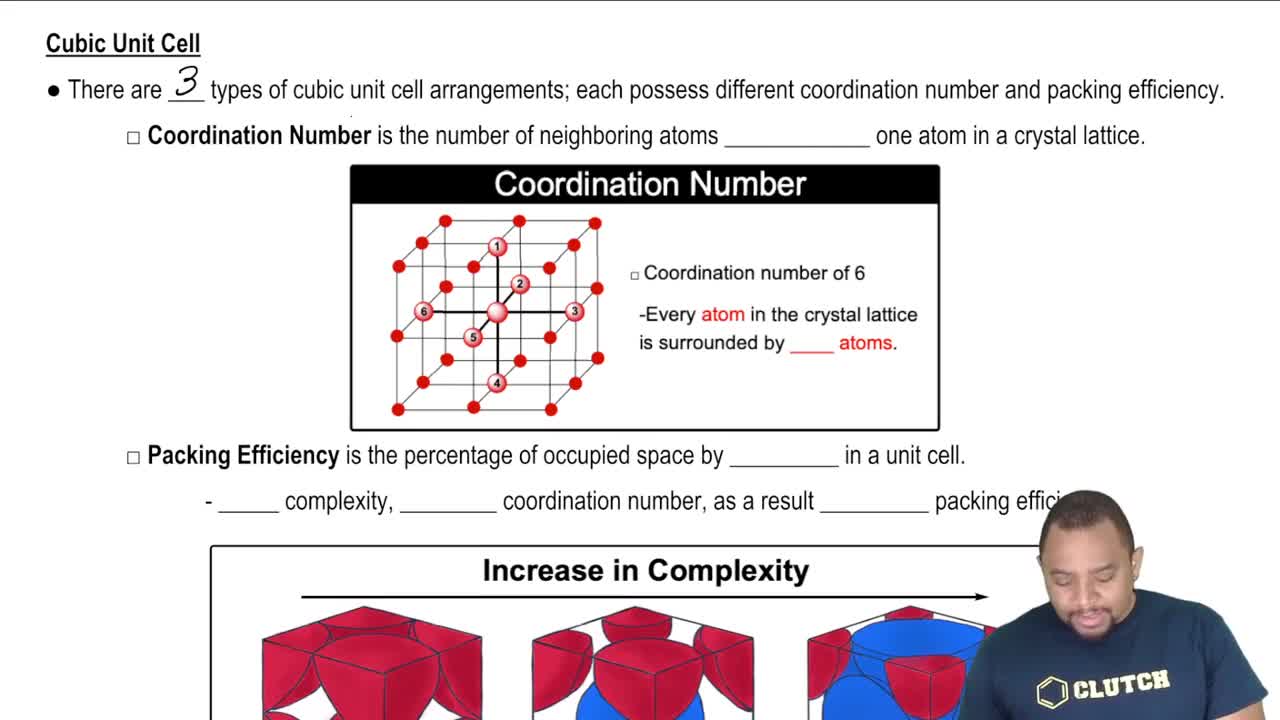
Cubic Unit Cells