Ch.12 - Solids and Solid-State Materials
McMurry - Chemistry 8th Edition
McMurry8th EditionChemistryISBN: 9781292336145Non è quello che usi tu?Cambia libro di testo
Capitolo 12, Problema 65

Sodium melts at 98 °C, and magnesium melts at 650 °C. Account for the higher melting point of magnesium using the electron-sea model.

Guida verificata passo dopo passo
1
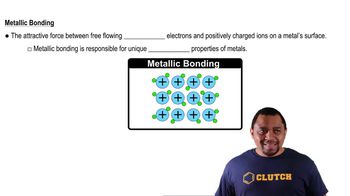
Step 1: Understand the electron-sea model. The electron-sea model is a model of metallic bonding in which cations are considered to be fixed points within a 'sea' of mobile electrons.
Step 2: Consider the atomic structure of sodium and magnesium. Sodium has one valence electron, while magnesium has two. This means that magnesium can contribute more electrons to the 'sea' of delocalized electrons than sodium.
Step 3: Understand the relationship between the number of delocalized electrons and the strength of metallic bonds. The more delocalized electrons, the stronger the metallic bonds. This is because the delocalized electrons can move freely and interact with a greater number of positive ions, creating a stronger bond.
Step 4: Apply this understanding to the given problem. Because magnesium contributes more delocalized electrons than sodium, it has stronger metallic bonds. This means that more energy (in the form of heat) is required to break these bonds and melt magnesium.
Step 5: Conclude that the higher melting point of magnesium compared to sodium can be explained by the electron-sea model. The greater number of delocalized electrons in magnesium leads to stronger metallic bonds and a higher melting point.

Risposta video verificata per un problema simile:

Questa soluzione video è stata consigliata dai nostri tutor come utile per risolvere questo problema.
Durata del video:
2m

Concetti chiave

Ecco i concetti essenziali che devi comprendere per rispondere correttamente alla domanda.

Electron-Sea Model

The electron-sea model describes metallic bonding as a structure where electrons are delocalized and free to move throughout a lattice of positively charged metal ions. This 'sea' of electrons allows metals to conduct electricity and contributes to their malleability and ductility. The strength of the metallic bond, influenced by the number of delocalized electrons, plays a crucial role in determining the melting point of metals.
Video consigliato:
Percorso guidato
02:43
Bohr Model of the Atom

Metallic Bonding Strength

The strength of metallic bonds varies among different metals, primarily due to the number of valence electrons that can participate in the electron-sea. Magnesium, with its two valence electrons, forms stronger metallic bonds compared to sodium, which has one. This increased bonding strength in magnesium results in a higher melting point, as more energy is required to overcome these bonds during the melting process.
Video consigliato:

Melting Point and Atomic Structure

The melting point of a substance is influenced by its atomic structure and the type of bonding present. In metals, a higher melting point typically indicates stronger metallic bonds and a more stable lattice structure. Magnesium's higher melting point compared to sodium can be attributed to its greater atomic mass and the stronger interactions between its ions and the delocalized electrons, leading to a more stable arrangement that requires more energy to disrupt.
Video consigliato:
Percorso guidato
04:29
Boiling Point and Melting Point