
Ch.12 - Solids and Solid-State Materials
McMurry - Chemistry 8th Edition
McMurry8th EditionChemistryISBN: 9781292336145Non è quello che usi tu?Cambia libro di testo
Capitolo 12, Problema 6

The following diagrams represent the electron population of the composite s–d band for three metals—Ag, Mo, and Y: Energy diagram showing bonding and antibonding states for metals in the course on solids.
Which diagram corresponds to which metal? (LO 12.7) (a) Ag = 3, Mo = 1, Y = 2 (b) Ag = 2, Mo = 1, Y = 3 (c) Ag = 2, Mo = 3, Y = 1 (d) Ag = 1, Mo = 2, Y = 3

Guida verificata passo dopo passo
1
Step 1: Understand the electron configuration of each metal (Ag, Mo, Y).
Step 2: Identify the number of electrons in the s and d bands for each metal.
Step 3: Analyze the given energy diagram and note the distribution of electrons in bonding and antibonding states.
Step 4: Compare the electron distribution in the diagram with the expected electron configurations of Ag, Mo, and Y.
Step 5: Match the diagram to the metal based on the electron population in the s-d band.

Risposta video verificata per un problema simile:

Questa soluzione video è stata consigliata dai nostri tutor come utile per risolvere questo problema.
Durata del video:
2m

Concetti chiave

Ecco i concetti essenziali che devi comprendere per rispondere correttamente alla domanda.

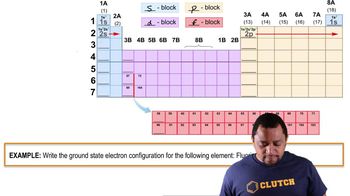
Electron Configuration

Electron configuration describes the distribution of electrons in an atom's orbitals. For metals, the arrangement of electrons in the s and d orbitals is crucial for understanding their chemical properties and bonding behavior. The specific filling of these orbitals influences the metal's conductivity, reactivity, and overall electronic structure.
Video consigliato:
Percorso guidato
01:33
Electron Configuration Example

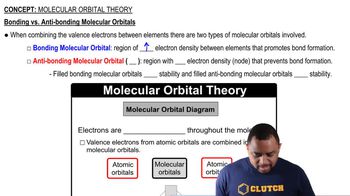
Bonding and Antibonding Orbitals

In molecular orbital theory, bonding orbitals are formed when atomic orbitals combine constructively, leading to lower energy states, while antibonding orbitals result from destructive interference, leading to higher energy states. The occupancy of these orbitals determines the stability and reactivity of the metal. Understanding how electrons populate these orbitals is essential for predicting the behavior of metals in various chemical contexts.
Video consigliato:
Percorso guidato
03:06
Molecular Orbital Theory

Metallic Bonding

Metallic bonding occurs due to the attraction between positively charged metal ions and delocalized electrons that are free to move throughout the structure. This delocalization allows metals to conduct electricity and heat efficiently. The strength and nature of metallic bonds can vary among different metals, influencing their physical properties and the arrangement of electrons in their s-d bands.
Video consigliato:
Pratica correlata
Domanda del libro di testo
The molecular orbital diagram of a doped semiconductor is shown below. If the semiconductor is silicon, does the diagram represent n-type or p-type doping and which of the following elements could be dopant? (LO 12.9)

(a) n-type, As (b) n-type, Ga (c) p-type, As (d) p-type, Ga
529
views
Domanda del libro di testo
Niobium oxide crystallizes in the following cubic unit cell:

What is the formula of niobium oxide, and what is the oxidation state of niobium? (LO 12.5) (a) NbO, Nb = +2 (b) Nb2O, Nb = +2 (c) NbO2, Nb = +4 (d) Nb2O3, Nb = +3
716
views
1
rank
Domanda del libro di testo
Examine diagrams for the electron population of the composite s–d band for three metals in question 6. Which metal has the highest melting point? (LO 12.7) (a) Metal 1 (b) Metal 2 (c) Metal 3

361
views
Domanda del libro di testo
Diffraction of X rays with l = 131.5 pm occurred at an angle of 25.5 degrees by a crystal of aluminum. Assuming first-order diffraction, what is the interplanar spacing in aluminum? (LO 12.2) (a) 76.4 pm (b) 183.1 pm (c) 305.5 pm (d) 152.7 pm
283
views
Domanda del libro di testo
The following diagrams represent the electron population of molecular orbitals for different substances. What diagram corresponds to magnesium oxide, germanium, and tin? (LO 12.8)

(a) Diagram 1 = tin, diagram 2 = magnesium oxide, diagram 3 = germanium (b) Diagram 1 = germanium, diagram 2 = magnesium oxide, diagram 3 = tin (c) Diagram 1 = germanium, diagram 2 = tin, diagram 3 = magnesium oxide (d) Diagram 1 = magnesium oxide, diagram 2 = tin, diagram 3 = germanium
265
views