Tungsten crystallizes in a body-centered cubic unit cell with
an edge length of 317 pm. What is the length in picometers
of a unit-cell diagonal that passes through the center atom?
Guida verificata passo dopo passo
1
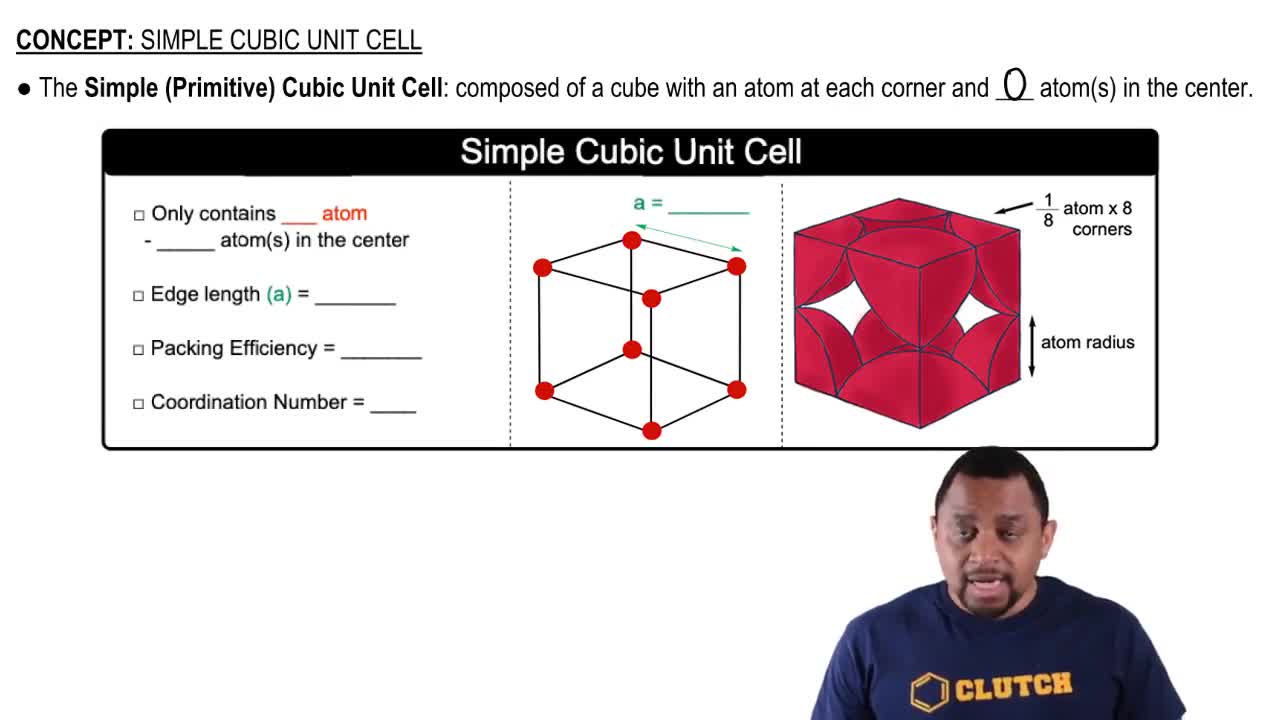
Identify the structure of the unit cell. In this case, tungsten crystallizes in a body-centered cubic (bcc) unit cell, which means there is an atom at each corner and one atom at the center of the cube.
Understand the geometry of the body-centered cubic unit cell. The diagonal that passes through the center atom connects opposite corners of the cube, passing through the center atom.
Use the Pythagorean theorem in three dimensions to relate the edge length of the cube (a) to the diagonal (d) that passes through the center. The formula for the body diagonal in a cube is given by: d = \(\sqrt{a^2 + a^2 + a^2}\) = a\(\sqrt{3}\).
Substitute the given edge length of the cube into the formula. In this case, the edge length a is 317 pm.
Calculate the length of the diagonal using the substituted values. This will give you the length of the unit-cell diagonal in picometers that passes through the center atom.
Risposta video verificata per un problema simile:
Questa soluzione video è stata consigliata dai nostri tutor come utile per risolvere questo problema.
Durata del video:
2m
Guarda un video:
0 Commenti
Concetti chiave
Ecco i concetti essenziali che devi comprendere per rispondere correttamente alla domanda.
Body-Centered Cubic (BCC) Structure
A body-centered cubic (BCC) structure is a type of crystal lattice where atoms are located at each corner of a cube and a single atom is positioned at the center of the cube. This arrangement results in a coordination number of 8, meaning each atom is in contact with eight neighboring atoms. Understanding this structure is essential for calculating properties like the unit cell diagonal.
The unit cell diagonal in a cubic structure is the line segment that connects two opposite corners of the cube, passing through the center atom. For a BCC unit cell, the length of this diagonal can be calculated using the Pythagorean theorem, taking into account the edge length of the cube. This diagonal is crucial for determining the spatial arrangement of atoms within the unit cell.
The Pythagorean theorem is a fundamental principle in geometry that relates the lengths of the sides of a right triangle. It states that the square of the length of the hypotenuse is equal to the sum of the squares of the lengths of the other two sides. This theorem is applied in calculating the unit cell diagonal by treating the diagonal as the hypotenuse of a right triangle formed by the edges of the cube.


 Guida verificata passo dopo passo
 00:40
00:40