
Ch.13 - Solutions & Their Properties
McMurry - Chemistry 8th Edition
McMurry8th EditionChemistryISBN: 9781292336145Non è quello che usi tu?Cambia libro di testo
Capitolo 13, Problema 116

A solution of citric acid, C6H8O7, in 50.0 g of acetic acid has a boiling point elevation of ΔT = 1.76 °C. What is the molality of the solution if the molal boilin# g-point-elevation constant for acetic acid is Kb = 3.07 1°C kg2>mol.

Guida verificata passo dopo passo
1
Identify the formula for boiling point elevation: \( \Delta T = K_b \times m \), where \( \Delta T \) is the boiling point elevation, \( K_b \) is the ebullioscopic constant, and \( m \) is the molality.
Rearrange the formula to solve for molality \( m \): \( m = \frac{\Delta T}{K_b} \).
Substitute the given values into the formula: \( \Delta T = 1.76 \, ^\circ\text{C} \) and \( K_b = 3.07 \, ^\circ\text{C} \, \text{kg/mol} \).
Calculate the molality \( m \) using the rearranged formula.
Remember that molality \( m \) is defined as moles of solute per kilogram of solvent, so the result will be in units of mol/kg.

Risposta video verificata per un problema simile:

Questa soluzione video è stata consigliata dai nostri tutor come utile per risolvere questo problema.
Durata del video:
2m

Concetti chiave

Ecco i concetti essenziali che devi comprendere per rispondere correttamente alla domanda.

Boiling Point Elevation

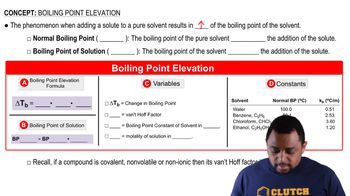
Boiling point elevation is a colligative property that describes how the boiling point of a solvent increases when a solute is dissolved in it. This phenomenon occurs because the presence of solute particles disrupts the solvent's ability to evaporate, requiring a higher temperature to reach the boiling point. The relationship is quantified by the formula ΔT = Kb * m, where ΔT is the boiling point elevation, Kb is the boiling point elevation constant, and m is the molality of the solution.
Video consigliato:
Percorso guidato
03:05
Boiling Point Elevation

Molality

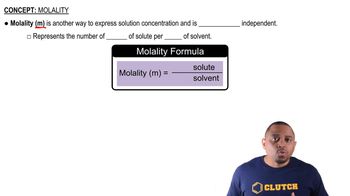
Molality (m) is a measure of the concentration of a solute in a solution, defined as the number of moles of solute per kilogram of solvent. It is particularly useful in colligative property calculations because it directly relates to the number of solute particles in a given mass of solvent, making it independent of temperature and volume changes. The formula for calculating molality is m = moles of solute / mass of solvent (in kg).
Video consigliato:

Colligative Properties

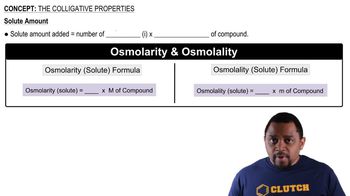
Colligative properties are properties of solutions that depend on the number of solute particles in a given amount of solvent, rather than the identity of the solute. These properties include boiling point elevation, freezing point depression, vapor pressure lowering, and osmotic pressure. Understanding colligative properties is essential for predicting how the addition of solute affects the physical properties of a solvent, which is crucial in various chemical applications.
Video consigliato:
Percorso guidato
01:26
Colligative Properties