
Ch.13 - Solutions & Their Properties
McMurry - Chemistry 8th Edition
McMurry8th EditionChemistryISBN: 9781292336145Non è quello che usi tu?Cambia libro di testo
Capitolo 13, Problema 139

A solution of LiCl in a mixture of water and methanol 1CH3OH2 has a vapor pressure of 39.4 mm Hg at 17 °C and 68.2 mm Hg at 27 °C. The vapor pressure of pure water is 14.5 mm Hg at 17 °C and 26.8 mm Hg at 27 °C, and the vapor pressure of pure methanol is 82.5 mm Hg at 17 °C and 140.3 mm Hg at 27 °C. What is the composition of the solution in mass percent?

Guida verificata passo dopo passo
1
Identify the components of the solution: LiCl, water, and methanol.
Use Raoult's Law to express the vapor pressure of the solution: \( P_{solution} = x_{water} \cdot P^0_{water} + x_{methanol} \cdot P^0_{methanol} \), where \( x \) is the mole fraction and \( P^0 \) is the vapor pressure of the pure component.
Set up equations for the vapor pressures at 17 °C and 27 °C using the given data and Raoult's Law.
Solve the system of equations to find the mole fractions of water and methanol in the solution at both temperatures.
Convert the mole fractions to mass percent by using the molar masses of water and methanol to find the mass of each component in the solution.

Risposta video verificata per un problema simile:

Questa soluzione video è stata consigliata dai nostri tutor come utile per risolvere questo problema.
Durata del video:
14m

Concetti chiave

Ecco i concetti essenziali che devi comprendere per rispondere correttamente alla domanda.

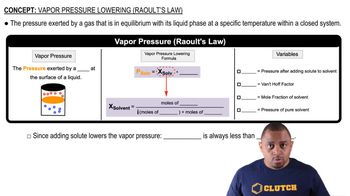
Raoult's Law

Raoult's Law states that the vapor pressure of a solvent in a solution is directly proportional to the mole fraction of the solvent present. This principle is crucial for understanding how the addition of a solute, like LiCl, affects the vapor pressure of the solvent mixture (water and methanol) and allows for the calculation of the composition of the solution.
Video consigliato:
Percorso guidato
02:40
Raoult's Law and Vapor Pressure

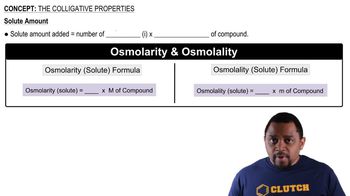
Colligative Properties

Colligative properties are properties of solutions that depend on the number of solute particles in a given amount of solvent, rather than the identity of the solute. These properties include vapor pressure lowering, boiling point elevation, and freezing point depression, which are essential for analyzing how the presence of LiCl alters the vapor pressures of the solvent mixture.
Video consigliato:
Percorso guidato
01:26
Colligative Properties

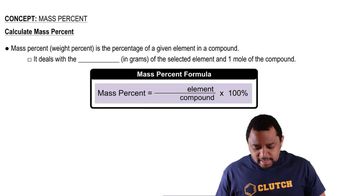
Mass Percent Composition

Mass percent composition is a way to express the concentration of a component in a mixture, calculated as the mass of the component divided by the total mass of the solution, multiplied by 100. Understanding this concept is vital for determining the mass percent of water and methanol in the solution after applying Raoult's Law and analyzing the vapor pressures.
Video consigliato:
Percorso guidato
00:38
Mass Percent Calculation