
Ch.13 - Solutions & Their Properties
McMurry - Chemistry 8th Edition
McMurry8th EditionChemistryISBN: 9781292336145Non è quello che usi tu?Cambia libro di testo
Capitolo 13, Problema 29

The following phase diagram shows part of the vapor- pressure curves for a pure liquid (green curve) and a solution of the first liquid with a second volatile liquid (red curve).Phase diagram showing vapor-pressure curves for a solvent (blue) and a solution (green).
(a) Is the boiling point of the second liquid higher or lower than that of the first liquid?

Guida verificata passo dopo passo
1
Identify the vapor-pressure curves for the pure liquid (solvent) and the solution from the phase diagram.
Understand that the boiling point is the temperature at which the vapor pressure of the liquid equals the external pressure (usually 1 atm).
Observe the temperatures at which the vapor pressure of the solvent and the solution reach 1 atm.
Note that the green curve (solution) reaches 1 atm at a higher temperature compared to the blue curve (solvent).
Conclude that the boiling point of the solution (second liquid) is higher than that of the pure solvent (first liquid).

Risposta video verificata per un problema simile:

Questa soluzione video è stata consigliata dai nostri tutor come utile per risolvere questo problema.
Durata del video:
1m

Concetti chiave

Ecco i concetti essenziali che devi comprendere per rispondere correttamente alla domanda.

Vapor Pressure

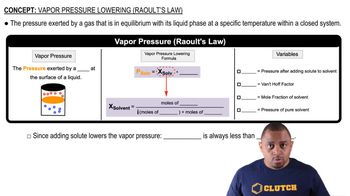
Vapor pressure is the pressure exerted by a vapor in equilibrium with its liquid or solid phase at a given temperature. It indicates how readily a substance evaporates; higher vapor pressure means a substance evaporates more easily. In the context of the phase diagram, the vapor pressure curves show how the pressure changes with temperature for both the pure liquid and the solution.
Video consigliato:
Percorso guidato
02:40
Raoult's Law and Vapor Pressure

Boiling Point

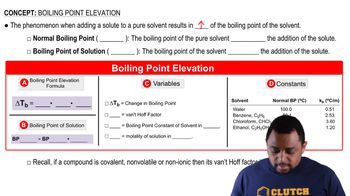
The boiling point of a liquid is the temperature at which its vapor pressure equals the external pressure surrounding the liquid. At this point, the liquid transitions to a gas. In the phase diagram, the boiling point can be determined by finding where the vapor pressure curve intersects the 1 atm line, which is crucial for comparing the boiling points of the first and second liquids.
Video consigliato:
Percorso guidato
03:05
Boiling Point Elevation

Raoult's Law

Raoult's Law states that the vapor pressure of a solvent in a solution is directly proportional to the mole fraction of the solvent present. When a volatile solute is added to a solvent, the overall vapor pressure of the solution decreases compared to the pure solvent. This principle helps explain why the boiling point of the solution (red curve) is higher than that of the pure solvent (green curve), indicating that the second liquid has a higher boiling point.
Video consigliato:
Percorso guidato
02:40
Raoult's Law and Vapor Pressure