
Ch.13 - Solutions & Their Properties
McMurry - Chemistry 8th Edition
McMurry8th EditionChemistryISBN: 9781292336145Non è quello che usi tu?Cambia libro di testo
Capitolo 13, Problema 133

There's actually much more in seawater than just dissolved NaCl. Major ions present include 19,000 ppm Cl-, 10,500 ppm Na+, 2650 ppm SO 2-, 1350 ppm Mg2+, 400 ppm Ca2+, 380 ppm K+, 140 ppm HCO3-, and 65 ppm Br-. (a) What is the total molality of all ions present in seawater?

Guida verificata passo dopo passo
1
Step 1: Convert the ppm (parts per million) of each ion to moles per kilogram of water. To do this, use the formula: moles = (ppm imes density of water) / (molecular weight of ion imes 1,000,000). Assume the density of water is approximately 1 kg/L.
Step 2: Calculate the moles of each ion separately using their respective molecular weights. For example, the molecular weight of Cl- is 35.45 g/mol, Na+ is 22.99 g/mol, SO4 2- is 96.06 g/mol, and so on.
Step 3: Sum the moles of all the ions calculated in Step 2 to find the total moles of ions in one kilogram of seawater.
Step 4: Since molality is defined as moles of solute per kilogram of solvent, and assuming seawater is mostly water, the total molality of all ions is approximately equal to the total moles of ions per kilogram of water calculated in Step 3.
Step 5: Report the total molality of all ions in seawater as the final answer.

Risposta video verificata per un problema simile:

Questa soluzione video è stata consigliata dai nostri tutor come utile per risolvere questo problema.
Durata del video:
6m

Concetti chiave

Ecco i concetti essenziali che devi comprendere per rispondere correttamente alla domanda.

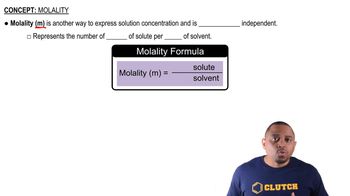
Molality

Molality is a measure of the concentration of a solute in a solution, defined as the number of moles of solute per kilogram of solvent. It is particularly useful in chemistry because it is independent of temperature and pressure, making it a reliable measure for reactions occurring in solution. To calculate molality, one must know the mass of the solvent and the number of moles of the solute.
Video consigliato:

Ionic Concentration

Ionic concentration refers to the amount of a specific ion present in a solution, typically expressed in parts per million (ppm) or molarity (moles per liter). In seawater, various ions such as Cl-, Na+, and SO4^2- contribute to its overall ionic strength. Understanding the concentration of these ions is crucial for calculating properties like molality and for comprehending the chemical behavior of seawater.
Video consigliato:

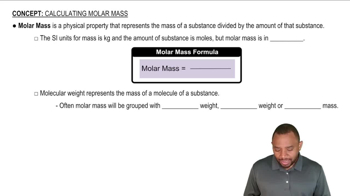
Molar Mass

Molar mass is the mass of one mole of a substance, usually expressed in grams per mole (g/mol). It is essential for converting between grams and moles when calculating concentrations in solutions. For the ions present in seawater, knowing their molar masses allows for the determination of the number of moles from the given concentrations in ppm, which is necessary for calculating total molality.
Video consigliato:
Percorso guidato
02:11
Molar Mass Concept