


Ch.13 - Solutions & Their Properties
McMurry - Chemistry 8th Edition
McMurry8th EditionChemistryISBN: 9781292336145Non è quello che usi tu?Cambia libro di testo
Capitolo 13, Problema 149a

Treatment of 1.385 g of an unknown metal M with an excess of aqueous HCl evolved a gas that was found to have a volume of 382.6 mL at 20.0 °C and 755 mm Hg pressure. Heating the reaction mixture to evaporate the water and remaining HCl then gave a white crystalline compound, MClx. After dissolving the compound in 25.0 g of water, the melting point of the resulting solution was - 3.53 °C. (b) What mass of MClx is formed? (a) How many moles of H2 gas are evolved?

Guida verificata passo dopo passo
1
Step 1: Use the ideal gas law to calculate the moles of H2 gas evolved. The ideal gas law is given by the equation \( PV = nRT \), where \( P \) is the pressure, \( V \) is the volume, \( n \) is the number of moles, \( R \) is the ideal gas constant, and \( T \) is the temperature in Kelvin.
Step 2: Convert the given pressure from mm Hg to atm. Use the conversion factor \( 1 \text{ atm} = 760 \text{ mm Hg} \).
Step 3: Convert the given volume from mL to L by dividing by 1000, since \( 1 \text{ L} = 1000 \text{ mL} \).
Step 4: Convert the temperature from Celsius to Kelvin by adding 273.15 to the Celsius temperature.
Step 5: Substitute the converted values into the ideal gas law equation to solve for \( n \), the number of moles of \( H_2 \) gas evolved. Use \( R = 0.0821 \text{ L atm K}^{-1} \text{ mol}^{-1} \) for the ideal gas constant.

Risposta video verificata per un problema simile:

Questa soluzione video è stata consigliata dai nostri tutor come utile per risolvere questo problema.
Durata del video:
3m

Concetti chiave

Ecco i concetti essenziali che devi comprendere per rispondere correttamente alla domanda.

Ideal Gas Law

The Ideal Gas Law relates the pressure, volume, temperature, and number of moles of a gas through the equation PV = nRT. This law is essential for calculating the number of moles of hydrogen gas evolved in the reaction, as it allows us to use the measured volume, temperature, and pressure to find the moles of gas produced.
Video consigliato:
Percorso guidato
01:15
Ideal Gas Law Formula

Molar Mass and Stoichiometry

Molar mass is the mass of one mole of a substance, typically expressed in grams per mole. In this problem, determining the molar mass of the unknown metal M and the resulting compound MClx is crucial for calculating the mass of MClx formed after the reaction. Stoichiometry involves using balanced chemical equations to relate the amounts of reactants and products.
Video consigliato:
Percorso guidato
02:11
Molar Mass Concept

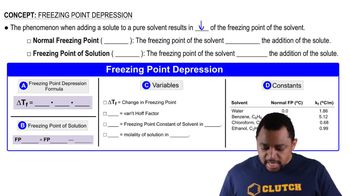
Freezing Point Depression

Freezing point depression is a colligative property that describes how the addition of a solute to a solvent lowers the freezing point of the solution. In this question, the change in freezing point of the water after dissolving MClx can be used to determine the molality of the solution, which is necessary for calculating the mass of MClx formed based on the number of moles of solute present.
Video consigliato:
Percorso guidato
01:59
Freezing Point Depression
Pratica correlata
Domanda del libro di testo
Addition of 50.00 mL of 2.238 m H2SO4 1solution density = 1.1243 g>mL2 to 50.00 mL of 2.238 M BaCl2 gives a white precipitate. (b) If you filter the mixture and add more H2SO4 solution to the filtrate, would you obtain more precipitate? Explain.
368
views
Domanda del libro di testo
Elemental analysis of b@carotene, a dietary source of vitamin A, shows that it contains 10.51% H and 89.49% C. Dissolving 0.0250 g of b@carotene in 1.50 g of camphor gives a freezing- point depression of 1.17 °C. What are the molecular weight and formula of b@carotene? [Kf for camphor is 37.7 1°C kg2>mol.]
545
views
Domanda del libro di testo

Treatment of 1.385 g of an unknown metal M with an excess of aqueous HCl evolved a gas that was found to have a volume of 382.6 mL at 20.0 °C and 755 mm Hg pressure. Heating the reaction mixture to evaporate the water and remaining HCl then gave a white crystalline compound, MClx. After dis- solving the compound in 25.0 g of water, the melting point of the resulting solution was - 3.53 °C. (f) What is the identity of the metal M?

411
views
Domanda del libro di testo

Treatment of 1.385 g of an unknown metal M with an excess of aqueous HCl evolved a gas that was found to have a volume of 382.6 mL at 20.0 °C and 755 mm Hg pressure. Heating the reaction mixture to evaporate the water and remaining HCl then gave a white crystalline compound, MClx. After dis- solving the compound in 25.0 g of water, the melting point of the resulting solution was - 3.53 °C. (c) What is the molality of particles (ions) in the solution of MClx?

329
views
Domanda del libro di testo

Treatment of 1.385 g of an unknown metal M with an excess of aqueous HCl evolved a gas that was found to have a volume of 382.6 mL at 20.0 °C and 755 mm Hg pressure. Heating the reaction mixture to evaporate the water and remaining HCl then gave a white crystalline compound, MClx. After dis- solving the compound in 25.0 g of water, the melting point of the resulting solution was - 3.53 °C. (e) What are the formula and molecular weight of MClx?

292
views