
Ch.13 - Solutions & Their Properties
McMurry - Chemistry 8th Edition
McMurry8th EditionChemistryISBN: 9781292336145Non è quello che usi tu?Cambia libro di testo
Capitolo 13, Problema 89

When solid CaCl2 is added to liquid water, the temperature rises. When solid CaCl2 is added to ice at 0 °C, the temperature falls. Explain.

Guida verificata passo dopo passo
1
Step 1: Understand the process of dissolving CaCl2 in water. When solid calcium chloride (CaCl2) is added to water, it dissolves and dissociates into its ions, Ca²⁺ and Cl⁻. This process is exothermic, meaning it releases heat, which causes the temperature of the water to rise.
Step 2: Consider the dissolution of CaCl2 in ice. When CaCl2 is added to ice at 0 °C, it also dissolves, but the situation is different because the ice must first melt to allow the dissolution process to occur.
Step 3: Recognize the energy requirement for melting ice. The melting of ice requires energy (endothermic process), which is absorbed from the surroundings, including the CaCl2 and the ice itself, causing the temperature to fall.
Step 4: Analyze the net effect. In the case of ice, the energy absorbed to melt the ice can be greater than the energy released by the dissolution of CaCl2, resulting in an overall temperature decrease.
Step 5: Summarize the contrasting effects. In liquid water, the exothermic dissolution of CaCl2 increases the temperature, while in ice, the endothermic melting process dominates, leading to a temperature decrease.

Concetti chiave

Ecco i concetti essenziali che devi comprendere per rispondere correttamente alla domanda.

Dissolution and Heat Transfer

When CaCl2 dissolves in water, it dissociates into calcium and chloride ions, a process that releases energy in the form of heat, leading to an increase in temperature. This exothermic reaction occurs because the energy released from forming ion-dipole interactions with water molecules is greater than the energy required to break the ionic bonds in solid CaCl2.
Video consigliato:

Endothermic Processes

In contrast, when CaCl2 is added to ice at 0 °C, the dissolution process absorbs heat from the surroundings, resulting in a temperature drop. This endothermic reaction occurs because the energy required to break the ionic bonds in solid CaCl2 and to disrupt the hydrogen bonding in ice exceeds the energy released from the formation of ion-dipole interactions with water molecules.
Video consigliato:
Percorso guidato
00:55
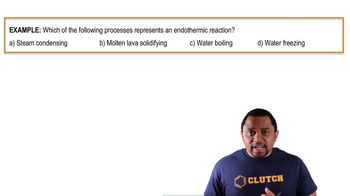
Endothermic & Exothermic Reactions Example 1

Phase Changes and Temperature Effects

The temperature of a substance is influenced by its phase. Ice, being a solid, requires energy to transition to liquid water. When CaCl2 is added to ice, it not only dissolves but also absorbs heat from the ice, which hinders the melting process and results in a decrease in temperature. This interplay between dissolution and phase change is crucial in understanding the thermal effects observed.
Video consigliato:
Percorso guidato
01:46
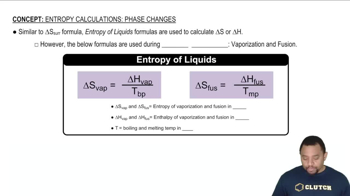
Entropy in Phase Changes