
Ch.14 - Chemical Kinetics
McMurry - Chemistry 8th Edition
McMurry8th EditionChemistryISBN: 9781292336145Non è quello che usi tu?Cambia libro di testo
Capitolo 14, Problema 127c

Consider the reversible, first-order interconversion of two molecules A and B: where kf = 3.0⨉10-3 s-1 is the rate constant for the forward reaction and kr = 1.0⨉10-3 s-1 is the rate constant for the reverse reaction. We'll see in Chapter 15 that a reaction does not go to completion but instead reaches a state of equilibrium with comparable concentrations of reactants and products if the rate constants kf and kr have comparable values.
(c) What are the relative concentrations of B and A when the rates of the forward and reverse reactions become equal?

Guida verificata passo dopo passo
1
Identify that the system is at equilibrium when the rates of the forward and reverse reactions are equal.
Write the rate expressions for the forward and reverse reactions: Rate_forward = k_f[A] and Rate_reverse = k_r[B].
Set the rate expressions equal to each other to represent the equilibrium condition: k_f[A] = k_r[B].
Rearrange the equation to solve for the ratio of concentrations: [B]/[A] = k_f/k_r.
Substitute the given rate constants into the equation: [B]/[A] = (3.0 \(\times\) 10^{-3} \(\text{ s}\)^{-1}) / (1.0 \(\times\) 10^{-3} \(\text{ s}\)^{-1}).

Risposta video verificata per un problema simile:

Questa soluzione video è stata consigliata dai nostri tutor come utile per risolvere questo problema.
Durata del video:
2m

Concetti chiave

Ecco i concetti essenziali che devi comprendere per rispondere correttamente alla domanda.

Equilibrium in Chemical Reactions

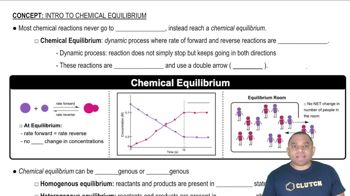
Equilibrium in a chemical reaction occurs when the rates of the forward and reverse reactions are equal, resulting in constant concentrations of reactants and products. At this point, the system is in a dynamic state where the conversion between reactants and products continues, but their concentrations remain unchanged over time.
Video consigliato:
Percorso guidato
04:21
Chemical Equilibrium Concepts

Rate Constants (k_f and k_r)

Rate constants, denoted as k_f for the forward reaction and k_r for the reverse reaction, quantify the speed of each reaction. The values of these constants are crucial in determining the position of equilibrium; when k_f equals k_r, the system reaches equilibrium, and the concentrations of A and B can be calculated based on these constants.
Video consigliato:
Percorso guidato
00:45
Rate Constant Units

Concentration Ratios at Equilibrium

At equilibrium, the ratio of the concentrations of products to reactants can be expressed using the rate constants. Specifically, the ratio of concentrations of B to A at equilibrium is given by the equation [B]/[A] = k_f/k_r. This relationship allows for the determination of relative concentrations when the rates of the forward and reverse reactions are equal.
Video consigliato:
Percorso guidato
02:14
Neutron-Proton Ratio
Pratica correlata
Domanda del libro di testo

Some reactions are so rapid that they are said to be diffusion-controlled; that is, the reactants react as quickly as they can collide. An example is the neutralization of H3O+ by OH-, which has a second-order rate constant of 1.3⨉1011 M-1 s-1 at 25 °C. (a) If equal volumes of 2.0 M HCl and 2.0 M NaOH are mixed instantaneously, how much time is required for 99.999% of the acid to be neutralized?

1078
views
Domanda del libro di testo
The half-life for the first-order decomposition of N2O4 is 1.3 * 10-5 s. N2O41g2S 2 NO21g2 If N2O4 is introduced into an evacuated flask at a pressure of 17.0 mm Hg, how many seconds are required for the pressure of NO2 to reach 1.3 mm Hg?
1180
views
Domanda del libro di testo

Consider the reversible, first-order interconversion of two molecules A and B: where kf = 3.0⨉10-3 s-1 is the rate constant for the forward reaction and kr = 1.0⨉10-3 s-1 is the rate constant for the reverse reaction. We'll see in Chapter 15 that a reaction does not go to completion but instead reaches a state of equilibrium with comparable concentrations of reactants and products if the rate constants kf and kr have comparable values.

(a) What are the rate laws for the forward and reverse reactions?

453
views
Domanda del libro di testo
Assume that you are studying the first-order conversion of a reactant X to products in a reaction vessel with a constant volume of 1.000 L. At 1 p.m., you start the reaction at 25 °C with 1.000 mol of X. At 2 p.m., you find that 0.600 mol of X remains, and you immediately increase the temperature of the reaction mixture to 35 °C. At 3 p.m., you discover that 0.200 mol of X is still present. You want to finish the reaction by 4 p.m. but need to continue it until only 0.010 mol of X remains, so you decide to increase the temperature once again. What is the minimum temperature required to convert all but 0.010 mol of X to products by 4 p.m.?
486
views
Domanda del libro di testo

Consider the following concentration–time data for the reaction of iodide ion and hypochlorite ion (OCl-). The products are chloride ion and hypoiodite ion (OI-).

(d) Propose a mechanism that is consistent with the rate law, and express the rate constant in terms of the rate constants for the elementary steps in your mechanism. (Hint: Transfer of an H+ ion between H2O and OCl- is a rapid reversible reaction.)

288
views
Domanda del libro di testo

Consider the reversible, first-order interconversion of two molecules A and B: where kf = 3.0⨉10-3 s-1 is the rate constant for the forward reaction and kr = 1.0⨉10-3 s-1 is the rate constant for the reverse reaction. We'll see in Chapter 15 that a reaction does not go to completion but instead reaches a state of equilibrium with comparable concentrations of reactants and products if the rate constants kf and kr have comparable values.

(b) Draw a qualitative graph that shows how the rates of the forward and reverse reactions vary with time.

363
views