
Ch.14 - Chemical Kinetics
McMurry - Chemistry 8th Edition
McMurry8th EditionChemistryISBN: 9781292336145Non è quello che usi tu?Cambia libro di testo
Capitolo 14, Problema 14

What is the total amount of heat absorbed (in kilojoules) after a reaction time of 10.0 min for the first-order decomposition of gaseous N2O5 to NO2 and O2 at 55 °C, given that the rate constant is 1.7 * 10^-3 s^-1?

Guida verificata passo dopo passo
1
Identify the reaction: The decomposition of N2O5 is a first-order reaction, which means the rate of reaction depends on the concentration of N2O5.
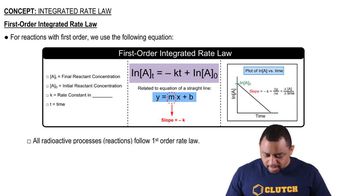
Use the first-order rate equation: The integrated rate law for a first-order reaction is \( [A] = [A]_0 e^{-kt} \), where \([A]\) is the concentration at time \(t\), \([A]_0\) is the initial concentration, \(k\) is the rate constant, and \(t\) is the time.
Calculate the fraction of N2O5 decomposed: Rearrange the integrated rate law to find the fraction decomposed: \( 1 - \frac{[A]}{[A]_0} = 1 - e^{-kt} \). Substitute \(k = 1.7 \times 10^{-3} \text{s}^{-1}\) and \(t = 10.0 \text{ min} \times 60 \text{ s/min} \) to find the fraction decomposed.
Determine the moles of N2O5 decomposed: If the initial moles of N2O5 are known, multiply by the fraction decomposed to find the moles of N2O5 that have decomposed.
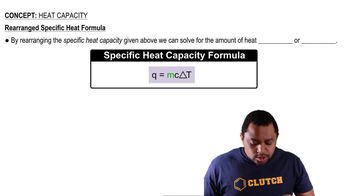
Calculate the heat absorbed: Use the stoichiometry of the reaction and the enthalpy change (if given or known) to calculate the total heat absorbed. The heat absorbed can be calculated using \( q = n \Delta H \), where \(n\) is the moles of N2O5 decomposed and \(\Delta H\) is the enthalpy change per mole of N2O5 decomposed.

Concetti chiave

Ecco i concetti essenziali che devi comprendere per rispondere correttamente alla domanda.

First-Order Reactions

First-order reactions are chemical reactions where the rate is directly proportional to the concentration of one reactant. In this case, the decomposition of N2O5 follows first-order kinetics, meaning that the rate constant (k) is used to determine how quickly the reactant is consumed over time. The integrated rate law for a first-order reaction can be used to calculate the concentration of reactants at any given time.
Video consigliato:
Percorso guidato
02:29
First-Order Reactions

Rate Constant (k)

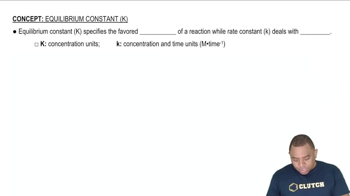
The rate constant (k) is a proportionality factor in the rate equation that is specific to a particular reaction at a given temperature. For first-order reactions, k has units of s^-1, indicating how fast the reaction proceeds. In this question, the rate constant of 1.7 * 10^-3 s^-1 is crucial for calculating the amount of N2O5 decomposed over the specified reaction time of 10.0 minutes.
Video consigliato:
Percorso guidato
01:14
Equilibrium Constant K

Heat Absorption in Reactions

The total amount of heat absorbed or released during a chemical reaction is related to the enthalpy change (ΔH) of the reaction. In this context, the heat absorbed can be calculated using the stoichiometry of the reaction and the amount of reactant consumed. Understanding how to relate the change in concentration of N2O5 to the heat absorbed is essential for solving the problem presented.
Video consigliato:
Pratica correlata
Domanda del libro di testo
A key reaction in the upper atmosphere is O31g2 + O1g2 ¡ 2 O21g2 For this process, the energy of activation for the forward reaction, Ea1fwd2, is 19 kJ/mol, and the enthalpy change for the reaction, ΔHrxn, is -392 kJ>mol. What is the energy of activation for the reverse reaction, Ea1reverse2? (LO 14.10) (a) 411 kJ/mol (b) 392 kJ/mol (c) 373 kJ/mol (d) 196 kJ/mol
528
views
Domanda del libro di testo

The following reaction is first order in A (red spheres) and first order in B (blue spheres): A + B → Products Rate = k[A][B]

(b) What are the relative values of the rate constant k for vessels (1)–(4)?

298
views
Domanda del libro di testo
(b) Write the balanced reaction that corresponds to the data in the graph.

838
views
2
rank
Domanda del libro di testo
Chlorine monoxide (ClO) decomposes at room temperature according to the reaction 2 ClO1g2¡Cl21g2 + O21g2 The concentration of ClO was monitored over time, and three graphs were made:

What is the rate law for the reaction? (LO 14.9) (a) Rate = k (b) Rate = k3ClO4 (c) Rate = k3ClO42 (d) Rate = k3ClO43 M14_MCMU6230_
384
views
Domanda del libro di testo

The following reaction is first order in A (red spheres) and first order in B (blue spheres): A + B → Products Rate = k[A][B]

(a) What are the relative rates of this reaction in vessels (1)–(4)? Each vessel has the same volume.

476
views
1
rank
Domanda del libro di testo
To answer questions 13–15, refer to the mechanism: H2O21aq2 + I-1aq2¡OH-1aq2 + HOI1aq2 Slower, rate-determining HOI1aq2 + I-1aq2¡OH-1aq2 + I21aq2 Faster 2 OH-1aq2 + 2 H3O+1aq2¡4 H2O1l2 Faster Identify the catalyst and intermediate(s) in the mechanism. (LO 14.12, 14.16) (a) Catalyst = I-, intermediates = OH-, HOI (b) Catalyst = H3O+, intermediate = HOI (c) No catalyst, intermediate = I2 (d) No catalyst, intermediates = OH-, HOI
456
views
1
rank