
Ch.14 - Chemical Kinetics
McMurry - Chemistry 8th Edition
McMurry8th EditionChemistryISBN: 9781292336145Non è quello che usi tu?Cambia libro di testo
Capitolo 14, Problema 110

The thermal decomposition of nitryl chloride, NO2Cl, is believed to occur by the following mechanism: NO2Cl1g2 ¡ k1 NO21g2 + Cl1g2 Cl1g2 + NO2Cl1g2 ¡ k2 NO21g2 + Cl21g2 (c) What rate law is predicted by this mechanism if the first step is rate-determining?

Guida verificata passo dopo passo
1
Identify the rate-determining step in the mechanism. In this case, the first step is the rate-determining step: NO_2Cl(g) -> NO_2(g) + Cl(g).
Write the rate law based on the rate-determining step. The rate law is determined by the slowest step, which involves the reactants in that step. Therefore, the rate law is: rate = k_1[NO_2Cl].
Since the first step is the rate-determining step, the overall rate of the reaction is governed by this step. The concentration of NO_2Cl is the only factor affecting the rate in this step.
Note that the rate constant k_1 is specific to the rate-determining step and reflects the speed of this step in the reaction mechanism.
Conclude that the predicted rate law for the decomposition of NO_2Cl, given the first step is rate-determining, is first-order with respect to NO_2Cl.

Risposta video verificata per un problema simile:

Questa soluzione video è stata consigliata dai nostri tutor come utile per risolvere questo problema.
Durata del video:
2m

Concetti chiave

Ecco i concetti essenziali che devi comprendere per rispondere correttamente alla domanda.

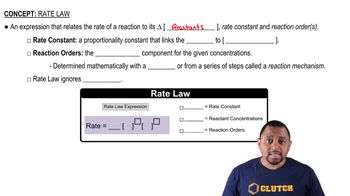
Rate Law

The rate law of a reaction expresses the relationship between the rate of a chemical reaction and the concentration of its reactants. It is typically formulated as rate = k[A]^m[B]^n, where k is the rate constant, and m and n are the orders of the reaction with respect to reactants A and B. Understanding the rate law is crucial for predicting how changes in concentration affect the reaction rate.
Video consigliato:
Percorso guidato
01:52
Rate Law Fundamentals

Rate-Determining Step

The rate-determining step (RDS) is the slowest step in a reaction mechanism that dictates the overall reaction rate. In a multi-step reaction, the RDS has the highest activation energy and thus limits the speed of the entire process. Identifying the RDS is essential for deriving the correct rate law, as it allows us to focus on the concentrations of the reactants involved in that specific step.
Video consigliato:
Percorso guidato
01:15
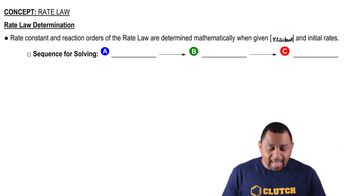
Rate Law Determination

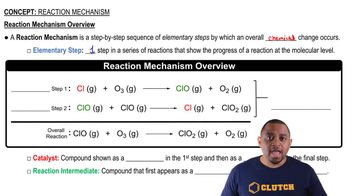
Elementary Reactions

Elementary reactions are single-step processes that occur in a chemical reaction mechanism. Each elementary reaction has a specific stoichiometry and can be directly related to the rate law. In the context of the given mechanism, understanding the elementary steps helps in determining how the concentrations of reactants influence the overall rate, especially when the first step is the rate-determining step.
Video consigliato:
Percorso guidato
03:06
Reaction Mechanism Overview