Ch.14 - Chemical Kinetics
McMurry - Chemistry 8th Edition
McMurry8th EditionChemistryISBN: 9781292336145Non è quello che usi tu?Cambia libro di testo
Capitolo 14, Problema 80

You wish to determine the reaction order and rate constant for the following thermal decomposition reaction: AB2 S 1>2 A2 + B2 (c) Describe how you would determine the value of the rate constant.

Guida verificata passo dopo passo
1
Start by identifying the reaction given: AB_2 \(\rightarrow\) \(\frac{1}{2}\) A_2 + B_2. The reaction order can be determined experimentally by measuring how the concentration of AB_2 changes over time.
The rate law for a reaction is generally expressed as rate = k [AB_2]^n, where k is the rate constant and n is the order of the reaction with respect to AB_2.
Perform a series of experiments to measure the concentration of AB_2 at various times. This data will help you determine the reaction order and rate constant.
Use the method of initial rates or integrate the rate law to find the reaction order. For example, if the reaction is first-order, a plot of ln[AB_2] versus time will yield a straight line, and the slope will be -k.
Once the reaction order is known, use the slope from the appropriate plot (e.g., ln[AB_2] vs. time for first-order) to calculate the rate constant k.>

Risposta video verificata per un problema simile:

Questa soluzione video è stata consigliata dai nostri tutor come utile per risolvere questo problema.
Durata del video:
4m

Concetti chiave

Ecco i concetti essenziali che devi comprendere per rispondere correttamente alla domanda.

Reaction Order

The reaction order is a key concept in chemical kinetics that indicates the relationship between the concentration of reactants and the rate of the reaction. It is determined experimentally and can be zero, first, second, or higher order, depending on how the rate changes with varying concentrations. For the given reaction, understanding the order helps in formulating the rate law, which is essential for calculating the rate constant.
Video consigliato:
Percorso guidato
00:36
Average Bond Order

Rate Law

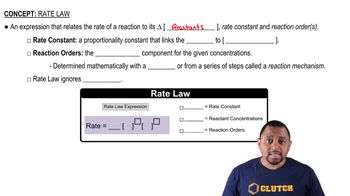
The rate law expresses the rate of a chemical reaction as a function of the concentration of its reactants, each raised to a power corresponding to its order in the reaction. For the decomposition of AB2, the rate law can be written as rate = k[AB2]^n, where k is the rate constant and n is the reaction order. Determining the rate law is crucial for finding the rate constant through experimental data.
Video consigliato:
Percorso guidato
01:52
Rate Law Fundamentals

Arrhenius Equation

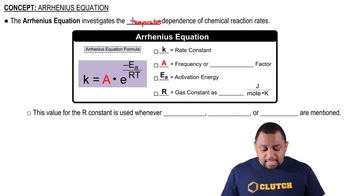
The Arrhenius equation relates the rate constant (k) of a reaction to the temperature (T) and activation energy (Ea) of the reaction. It is expressed as k = A * e^(-Ea/RT), where A is the pre-exponential factor, R is the gas constant, and T is the temperature in Kelvin. This equation is vital for determining the rate constant at different temperatures and understanding how temperature influences reaction rates.
Video consigliato:
Percorso guidato
01:20
Arrhenius Equation