Ch.15 - Chemical Equilibrium
McMurry - Chemistry 8th Edition
McMurry8th EditionChemistryISBN: 9781292336145Non è quello che usi tu?Cambia libro di testo
Capitolo 15, Problema 15.64

Calculate the value of the equilibrium constant at 427 °C for the reaction
Na O1s2 + 1>2 O 1g2 ∆ Na O 1s2
given the following equilibrium constants at 427 °C.
Na2O1s2 ∆ 2 Na1l2 + 1>2 O21g2 Kc = 2 * 10-25 Na O 1s2 ∆ 2 Na1l2 + O 1g2 K = 5 * 10-29

Guida verificata passo dopo passo
1
Identify the target reaction and the given reactions. The target reaction is Na2O(s) + 1/2 O2(g) ⇌ Na2O2(s). The given reactions are: (1) Na2O(s) ⇌ 2 Na(l) + 1/2 O2(g) with Kc = 2 * 10^-25, and (2) Na2O2(s) ⇌ 2 Na(l) + O2(g) with K = 5 * 10^-29.
Write the reverse of the second given reaction to align with the formation of Na2O2(s) from Na(l) and O2(g), which is 2 Na(l) + O2(g) ⇌ Na2O2(s). The equilibrium constant for this reverse reaction will be the reciprocal of the given K, which is 1/(5 * 10^-29).
Combine the first given reaction with the reversed second reaction to achieve the target reaction. This involves adding the first reaction to the reversed second reaction. The combined reaction should yield Na2O(s) + 1/2 O2(g) ⇌ Na2O2(s).
Apply the law of mass action to find the equilibrium constant for the target reaction, K_target. The equilibrium constant for a reaction obtained by adding two reactions is the product of the equilibrium constants of the individual reactions. Therefore, K_target = Kc for the first reaction * K for the reversed second reaction.
Calculate K_target using the values of Kc and K from the previous steps. This will give the equilibrium constant for the target reaction at 427 °C.

Risposta video verificata per un problema simile:

Questa soluzione video è stata consigliata dai nostri tutor come utile per risolvere questo problema.
Durata del video:
6m

Concetti chiave

Ecco i concetti essenziali che devi comprendere per rispondere correttamente alla domanda.

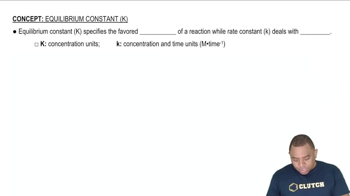
Equilibrium Constant (K)

The equilibrium constant (K) is a numerical value that expresses the ratio of the concentrations of products to reactants at equilibrium for a given chemical reaction. It is temperature-dependent and provides insight into the extent of a reaction; a larger K indicates a greater concentration of products at equilibrium, while a smaller K suggests that reactants are favored.
Video consigliato:
Percorso guidato
01:14
Equilibrium Constant K

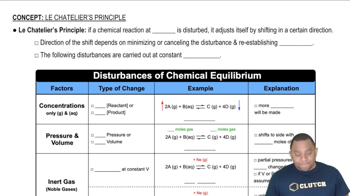
Le Chatelier's Principle

Le Chatelier's Principle states that if a dynamic equilibrium is disturbed by changing the conditions, the system will adjust itself to counteract the change and restore a new equilibrium. This principle is crucial for predicting how changes in concentration, pressure, or temperature will affect the position of equilibrium in a chemical reaction.
Video consigliato:
Percorso guidato
07:32
Le Chatelier's Principle

Reaction Stoichiometry

Reaction stoichiometry involves the quantitative relationships between the reactants and products in a chemical reaction, as described by the balanced chemical equation. Understanding stoichiometry is essential for calculating equilibrium constants, as it allows for the proper interpretation of the coefficients in the balanced equation, which directly influence the equilibrium expression.
Video consigliato:
Percorso guidato
01:16
Stoichiometry Concept