
Ch.15 - Chemical Equilibrium
McMurry - Chemistry 8th Edition
McMurry8th EditionChemistryISBN: 9781292336145Non è quello che usi tu?Cambia libro di testo
Capitolo 15, Problema 45

Consider the reaction A + B ∆ AB. The vessel on the right contains an equilibrium mixture of A molecules (red spheres), B molecules (blue spheres), and AB molecules. If the stopcock is opened and the contents of the two vessels are allowed to mix, will the reaction go in the forward or reverse direction? Explain. Two vessels showing red A, blue B, and green AB molecules in equilibrium for Le Chatelier's Principle.

Guida verificata passo dopo passo
1
Identify the initial conditions in both vessels. The left vessel contains a mixture of A, B, and AB molecules, while the right vessel contains only AB molecules.
Determine the direction of the reaction based on the initial concentrations. The left vessel has a higher concentration of A and B molecules compared to the right vessel.
Apply Le Chatelier's Principle, which states that the system will shift to counteract the change. Since the right vessel has only AB molecules, opening the stopcock will increase the concentration of AB in the left vessel.
Predict the direction of the reaction. The system will shift to reduce the concentration of AB by converting some AB molecules back into A and B molecules.
Conclude that the reaction will proceed in the reverse direction (AB -> A + B) when the stopcock is opened, as the system seeks to re-establish equilibrium.

Risposta video verificata per un problema simile:

Questa soluzione video è stata consigliata dai nostri tutor come utile per risolvere questo problema.
Durata del video:
3m

Concetti chiave

Ecco i concetti essenziali che devi comprendere per rispondere correttamente alla domanda.

Chemical Equilibrium

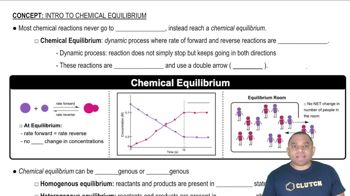
Chemical equilibrium occurs when the rates of the forward and reverse reactions are equal, resulting in constant concentrations of reactants and products. In the given reaction A + B ⇌ AB, the system reaches equilibrium when the formation of AB from A and B occurs at the same rate as the decomposition of AB back into A and B. Understanding this concept is crucial for predicting how changes in conditions affect the reaction.
Video consigliato:
Percorso guidato
04:21
Chemical Equilibrium Concepts

Le Chatelier's Principle

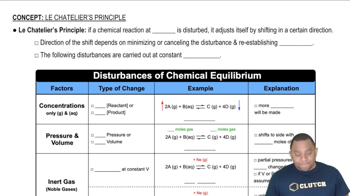
Le Chatelier's Principle states that if a dynamic equilibrium is disturbed by changing the conditions, the system will adjust to counteract the change and restore a new equilibrium. In this scenario, opening the stopcock allows the mixing of reactants and products, potentially shifting the equilibrium position depending on the concentrations of A, B, and AB in the combined vessel.
Video consigliato:
Percorso guidato
07:32
Le Chatelier's Principle

Concentration Changes

Changes in concentration of reactants or products can influence the direction of a chemical reaction. When the stopcock is opened, the concentrations of A and B may decrease while the concentration of AB may increase, depending on the initial amounts in each vessel. This shift in concentration can drive the reaction either forward or backward, depending on the relative amounts of each species present.
Video consigliato:
Percorso guidato
01:53
Chemical Changes
Pratica correlata
Domanda del libro di testo
The reaction A2 + B ∆ A + AB has an equilibrium con-stant Kc = 2. The following pictures represent reaction mix- tures that contain A atoms (red), B atoms (blue), and A2 and AB molecules.

(a) Which reaction mixture is at equilibrium?
530
views
Domanda del libro di testo
Consider the interconversion of A molecules (red spheres) and B molecules (blue spheres) according to the reaction A ∆ B. Each of the series of pictures at the right represents a separate experiment in which time increases from left to right: (b) What is the value of the equilibrium constant Kc for the reaction A ∆ B?

577
views
Domanda del libro di testo
The following pictures represent the composition of the equi- librium mixture for the reaction A + B ∆ AB at 300 K and at 400 K.

Is the reaction exothermic or endothermic? Explain using Le Châtelier's principle.
380
views
Domanda del libro di testo

The following pictures represent the initial state and the equilibrium state for the reaction of A2 molecules (red) with B atoms (blue) to give AB molecules. (a) Write a balanced chemical equation for the reaction.

509
views
Domanda del libro di testo
The following picture represents the equilibrium state for the reaction 2 AB ∆ A2 + B2. Which rate constant is larger, kf or kr? Explain.
863
views
1
rank
Domanda del libro di testo
The following picture represents the composition of the equi- librium mixture for the endothermic reaction A2 ∆ 2 A at 500 K. Draw a picture that represents the equilibrium mixture after each of the following changes. (b) Increasing the volume

311
views