Ch.15 - Chemical Equilibrium
McMurry - Chemistry 8th Edition
McMurry8th EditionChemistryISBN: 9781292336145Non è quello che usi tu?Cambia libro di testo
Capitolo 15, Problema 134

For the reaction A2 + 2B ∆ 2 AB, the rate of the for- ward reaction is 18 M/s and the rate of the reverse reaction is 12 M/s. The reaction is not at equilibrium. Will the reaction pro- ceed in the forward or reverse direction to attain equilibrium?

Guida verificata passo dopo passo
1
Identify the rates of the forward and reverse reactions. The rate of the forward reaction is given as 18 M/s, and the rate of the reverse reaction is 12 M/s.
Understand that at equilibrium, the rate of the forward reaction equals the rate of the reverse reaction.
Compare the given rates: since the rate of the forward reaction (18 M/s) is greater than the rate of the reverse reaction (12 M/s), the reaction system is producing AB faster than it is being converted back to A2 and B.
Determine the direction needed to reach equilibrium: To achieve equilibrium, the system needs to slow down the forward reaction or speed up the reverse reaction until both rates are equal.
Conclude that the reaction will proceed in the forward direction to increase the concentration of products (AB), which will eventually increase the rate of the reverse reaction and help attain equilibrium.

Risposta video verificata per un problema simile:

Questa soluzione video è stata consigliata dai nostri tutor come utile per risolvere questo problema.
Durata del video:
1m

Concetti chiave

Ecco i concetti essenziali che devi comprendere per rispondere correttamente alla domanda.

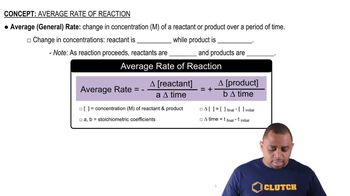
Reaction Rates

Reaction rates refer to the speed at which reactants are converted into products in a chemical reaction. In this case, the forward reaction rate is 18 M/s, while the reverse reaction rate is 12 M/s. Understanding these rates is crucial for determining the direction in which the reaction will proceed to reach equilibrium.
Video consigliato:
Percorso guidato
02:03
Average Rate of Reaction

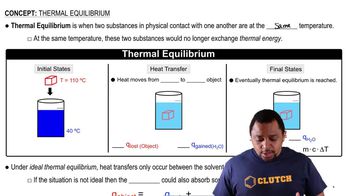
Equilibrium

Chemical equilibrium occurs when the rates of the forward and reverse reactions are equal, resulting in constant concentrations of reactants and products. In this scenario, since the forward reaction rate (18 M/s) is greater than the reverse reaction rate (12 M/s), the system is not at equilibrium and will shift towards the formation of more products to achieve balance.
Video consigliato:
Percorso guidato
02:35
Thermal Equilibrium

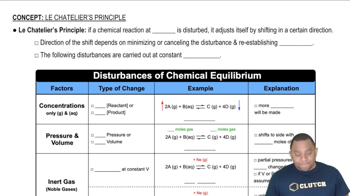
Le Chatelier's Principle

Le Chatelier's Principle states that if a system at equilibrium is disturbed, it will adjust to counteract the disturbance and restore a new equilibrium. In this case, since the forward reaction is faster, the system will favor the forward direction to increase the concentration of products (AB) until the rates of both reactions equalize.
Video consigliato:
Percorso guidato
07:32
Le Chatelier's Principle
Pratica correlata
Domanda del libro di testo
Consider a general, single-step reaction of the type A + B ∆ C. Show that the equilibrium constant is equal to the ratio of the rate constants for the forward and reverse reactions, Kc = kf>kr.
537
views

Domanda del libro di testo
Which of the following relative values of kf and kr results in an equilibrium mixture that contains large amounts of reactants and small amounts of products? (a) kf 7 kr (b) kf = kr (c) kf 6 kr
1058
views
Domanda del libro di testo
Consider the reaction of chloromethane with OH- in aque- ous solution: CH Cl1aq2 + OH-1aq2 ∆kf CH OH1aq2 + Cl-1aq2 At 25 °C, the rate constant for the forward reaction is 6 * 10-6 M-1 s-1, and the equilibrium constant Kc is 1 * 1016. Calculate the rate constant for the reverse reac- tion at 25 °C.
380
views
Domanda del libro di testo
A platinum catalyst is used in automobile catalytic convert- ers to hasten the oxidation of carbon monoxide: 2 CO1g2 + O 1g2 ∆Pt 2 CO 1g2 ΔH° = - 566 kJ Suppose that you have a reaction vessel containing an equilibrium mixture of CO1g2, O21g2, and CO21g2. Under the following conditions, will the amount of CO increase, decrease, or remain the same? (e) The pressure is increased by adding O2 gas.
496
views
Domanda del libro di testo
Baking soda (sodium bicarbonate) decomposes when it is heated: 2 NaHCO31s2 ∆ Na2CO31s2 + CO21g2 + H2O1g2 ΔH° = + 136 kJ Consider an equilibrium mixture of reactants and products in a closed container. How does the number of moles of CO2 change when the mixture is disturbed by the following: (b) Adding water vapor
1103
views