
Ch.15 - Chemical Equilibrium
McMurry - Chemistry 8th Edition
McMurry8th EditionChemistryISBN: 9781292336145Non è quello che usi tu?Cambia libro di testo
Capitolo 15, Problema 143

Given the Arrhenius equation, k = Ae-Ea>RT, and the rela- tion between the equilibrium constant and the forward and reverse rate constants, Kc = kf>kr, explain why Kc for an exothermic reaction decreases with increasing temperature.

Guida verificata passo dopo passo
1
Step 1: Understand the Arrhenius equation. The Arrhenius equation, k = Ae^(-Ea/RT), describes how the rate constant (k) of a reaction depends on the temperature (T). Here, A is the pre-exponential factor, Ea is the activation energy, R is the gas constant, and T is the temperature. The equation shows that as temperature increases, the rate constant also increases, but this increase is moderated by the activation energy.
Step 2: Understand the relationship between equilibrium constant and rate constants. The equilibrium constant (Kc) is the ratio of the forward rate constant (kf) to the reverse rate constant (kr), as given by Kc = kf/kr. This means that the equilibrium constant depends on the rates of the forward and reverse reactions.
Step 3: Consider an exothermic reaction. In an exothermic reaction, the forward reaction releases energy (negative Ea), while the reverse reaction requires energy (positive Ea). Therefore, according to the Arrhenius equation, an increase in temperature will have a greater effect on the rate constant of the reverse reaction (kr) than on the forward reaction (kf).
Step 4: Apply the relationship between equilibrium constant and rate constants. As temperature increases, both kf and kr increase, but kr increases more. Therefore, the ratio kf/kr (which is Kc) decreases.
Step 5: Therefore, for an exothermic reaction, the equilibrium constant Kc decreases with increasing temperature. This is because the increase in temperature favors the endothermic reverse reaction more than the exothermic forward reaction, shifting the equilibrium towards the reactants and decreasing Kc.

Risposta video verificata per un problema simile:

Questa soluzione video è stata consigliata dai nostri tutor come utile per risolvere questo problema.
Durata del video:
3m

Concetti chiave

Ecco i concetti essenziali che devi comprendere per rispondere correttamente alla domanda.

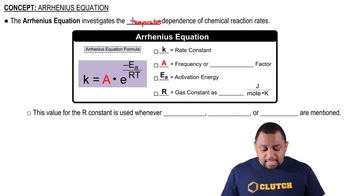
Arrhenius Equation

The Arrhenius equation describes how the rate constant (k) of a chemical reaction depends on temperature (T) and activation energy (Ea). It states that k = Ae^(-Ea/RT), where A is the pre-exponential factor. As temperature increases, the exponential term becomes larger, leading to an increase in k, which generally accelerates the reaction rate.
Video consigliato:
Percorso guidato
01:20
Arrhenius Equation

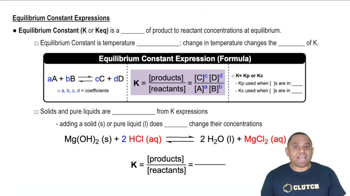
Equilibrium Constant (Kc)

The equilibrium constant (Kc) quantifies the ratio of the concentrations of products to reactants at equilibrium for a reversible reaction. For a reaction with forward rate constant (kf) and reverse rate constant (kr), Kc = kf/kr. Changes in temperature can affect kf and kr differently, influencing the value of Kc.
Video consigliato:
Percorso guidato
03:20
Equilibrium Constant Expressions

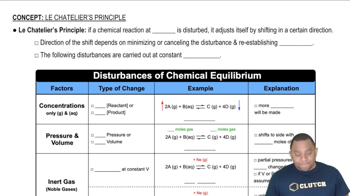
Le Chatelier's Principle

Le Chatelier's Principle states that if a system at equilibrium is subjected to a change in temperature, pressure, or concentration, the system will adjust to counteract that change and restore a new equilibrium. For exothermic reactions, increasing temperature shifts the equilibrium position towards the reactants, resulting in a decrease in Kc.
Video consigliato:
Percorso guidato
07:32
Le Chatelier's Principle
Pratica correlata
Domanda del libro di testo
In automobile catalytic converters, the air pollutant nitric oxide is converted to nitrogen and oxygen. Listed in the table are forward and reverse rate constants for the reac- tion 2 NO1g2 ∆ N21g2 + O21g2. Temperature (K) kf1M — 1 s-12 kr1M-1 s — 12 1400 0.29 1.1 * 10-6 1500 1.3 1.4 * 10-5 Is the reaction endothermic or exothermic? Explain in terms of kinetics.
429
views
Domanda del libro di testo

Refining petroleum involves cracking large hydrocarbon molecules into smaller, more volatile pieces. A simple example of hydrocarbon cracking is the gas-phase thermal decomposition of butane to give ethane and ethylene: (a) Write the equilibrium constant expressions for Kp and Kc.

322
views
Domanda del libro di testo
Heavy water, symbolized D2O 1D = 2H2 finds use as a neutron moderator in nuclear reactors. In a mixture with ordinary water, exchange of isotopes occurs according to the following equation: H2O + D2O ∆ 2 HDO Kc = 3.86 at 298 K When 1.00 mol of H2O is combined with 1.00 mol of D2O, what are the equilibrium amounts of H2O, D2O, and HDO (in moles) at 298 K? Assume the density of the mixture is constant at 1.05 g>cm3.
285
views
Domanda del libro di testo
Consider the reaction of chloromethane with OH- in aque- ous solution: CH Cl1aq2 + OH-1aq2 ∆kf CH OH1aq2 + Cl-1aq2 At 25 °C, the rate constant for the forward reaction is 6 * 10-6 M-1 s-1, and the equilibrium constant Kc is 1 * 1016. Calculate the rate constant for the reverse reac- tion at 25 °C.
380
views
Domanda del libro di testo
Vinegar contains acetic acid, a weak acid that is partially dissociated in aqueous solution: CH3CO2H1aq2 ∆ H+ 1aq2 + CH3CO-1aq2 (b) What is the value of Kc if the extent of dissociation in 1.0 M CH3CO2H is 0.42%?
640
views