Ch.15 - Chemical Equilibrium
McMurry - Chemistry 8th Edition
McMurry8th EditionChemistryISBN: 9781292336145Non è quello che usi tu?Cambia libro di testo
Capitolo 15, Problema 15.60b

If Kc = 7.5×10⁻⁹ at 1000 K for the reaction N2(g) + O2(g) → 2 NO(g), give the value of Kc at 1000 K for the reaction
(b) NO(g) → 1/2 N2(g) + 1/2 O2(g)

Guida verificata passo dopo passo
1
Identify the given equilibrium constant \( K_c = 7.5 \times 10^{-9} \) for the reaction \( \text{N}_2(g) + \text{O}_2(g) \rightarrow 2 \text{NO}(g) \).
Recognize that the reaction in part (b) is the reverse of the given reaction, but with coefficients halved: \( \text{NO}(g) \rightarrow \frac{1}{2} \text{N}_2(g) + \frac{1}{2} \text{O}_2(g) \).
Recall that when a reaction is reversed, the equilibrium constant for the reverse reaction is the reciprocal of the original reaction's equilibrium constant.
Understand that when the coefficients of a balanced equation are multiplied by a factor, the equilibrium constant is raised to the power of that factor.
Calculate the new equilibrium constant by taking the reciprocal of \( K_c \) and then raising it to the power of \( \frac{1}{2} \) to account for the change in coefficients.

Risposta video verificata per un problema simile:

Questa soluzione video è stata consigliata dai nostri tutor come utile per risolvere questo problema.
Durata del video:
2m

Concetti chiave

Ecco i concetti essenziali che devi comprendere per rispondere correttamente alla domanda.

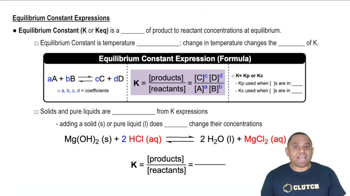
Equilibrium Constant (Kc)

The equilibrium constant (Kc) is a numerical value that expresses the ratio of the concentrations of products to reactants at equilibrium for a given reaction at a specific temperature. It is calculated using the formula Kc = [products]^[coefficients] / [reactants]^[coefficients]. A small Kc value, like 7.5×10^−9, indicates that at equilibrium, the reaction favors the reactants over the products.
Video consigliato:
Percorso guidato
03:20
Equilibrium Constant Expressions

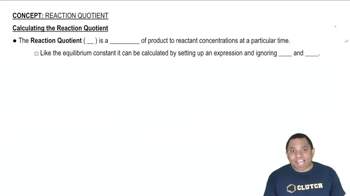
Reaction Quotient (Q)

The reaction quotient (Q) is a measure of the relative concentrations of products and reactants at any point in time during a reaction. It is calculated in the same way as Kc but does not require the system to be at equilibrium. Comparing Q to Kc helps predict the direction in which a reaction will proceed to reach equilibrium.
Video consigliato:
Percorso guidato
00:49
Reaction Quotient Q

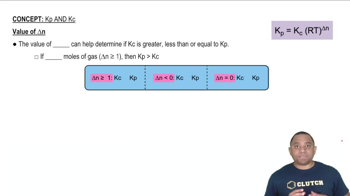
Reverse Reaction and Kc Relationship

For a given reaction, the equilibrium constant for the reverse reaction is the reciprocal of the equilibrium constant for the forward reaction. If Kc for the forward reaction is known, Kc for the reverse reaction can be calculated as Kc(reverse) = 1/Kc(forward). This relationship is crucial for determining Kc for the reaction given in the question, which is the reverse of the original reaction.
Video consigliato:
Percorso guidato
02:18
Kp vs Kc Relationship