
Ch.15 - Chemical Equilibrium
McMurry - Chemistry 8th Edition
McMurry8th EditionChemistryISBN: 9781292336145Non è quello che usi tu?Cambia libro di testo
Capitolo 15, Problema 94

Recalculate the equilibrium concentrations in Problem 15.93 if the initial concentrations are 2.24 M N2 and 0.56 M O2. (This N2>O2 concentration ratio is the ratio found in air.)

Guida verificata passo dopo passo
1
Identify the balanced chemical equation for the reaction involving N2 and O2. For example, if the reaction is N2 + O2 ⇌ 2NO, write it down.
Write the expression for the equilibrium constant (Kc) based on the balanced equation. For the example reaction, Kc = [NO]^2 / ([N2][O2]).
Set up an ICE (Initial, Change, Equilibrium) table to track the concentrations of reactants and products. Start with the initial concentrations: [N2] = 2.24 M, [O2] = 0.56 M, and assume [NO] = 0 M initially.
Define the change in concentration for each species in terms of a variable, usually x. For example, if x is the change in concentration of NO, then the changes for N2 and O2 would be -x/2 and -x/2, respectively, based on stoichiometry.
Substitute the equilibrium concentrations from the ICE table into the Kc expression and solve for x. Use this value to find the equilibrium concentrations of all species.

Risposta video verificata per un problema simile:

Questa soluzione video è stata consigliata dai nostri tutor come utile per risolvere questo problema.
Durata del video:
3m

Concetti chiave

Ecco i concetti essenziali che devi comprendere per rispondere correttamente alla domanda.

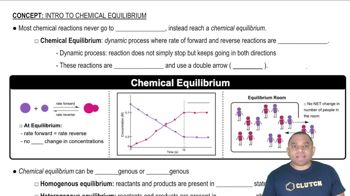
Chemical Equilibrium

Chemical equilibrium occurs when the rates of the forward and reverse reactions are equal, resulting in constant concentrations of reactants and products. At equilibrium, the system's composition remains unchanged over time, and the equilibrium constant (K) can be used to express the ratio of product concentrations to reactant concentrations at this state.
Video consigliato:
Percorso guidato
04:21
Chemical Equilibrium Concepts

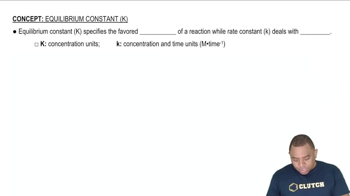
Equilibrium Constant (K)

The equilibrium constant (K) is a numerical value that expresses the ratio of the concentrations of products to reactants at equilibrium, each raised to the power of their coefficients in the balanced chemical equation. It provides insight into the position of equilibrium; a large K indicates a reaction that favors products, while a small K suggests reactants are favored.
Video consigliato:
Percorso guidato
01:14
Equilibrium Constant K

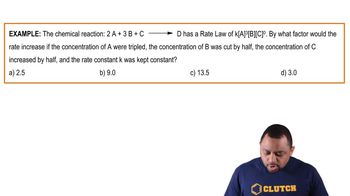
Initial Concentrations and Changes

In equilibrium problems, the initial concentrations of reactants and products are crucial for determining how the system will shift to reach equilibrium. Changes in concentration, often represented by 'x', are calculated based on the stoichiometry of the reaction, allowing for the determination of equilibrium concentrations by applying the initial values and the changes that occur as the system stabilizes.
Video consigliato:
Percorso guidato
02:10
Concentration Changes and Rate Law Example