
Ch.15 - Chemical Equilibrium
McMurry - Chemistry 8th Edition
McMurry8th EditionChemistryISBN: 9781292336145Non è quello che usi tu?Cambia libro di testo
Capitolo 15, Problema 111

The equilibrium constant Kc for the reaction N21g2 + 3 H21g2 ∆ 2 NH31g2 is 4.20 at 600 K. When a quantity of gaseous NH3 was placed in a 1.00-L reaction vessel at 600 K and the reaction was allowed to reach equilibrium, the vessel was found to contain 0.200 mol of N2. How many moles of NH3 were placed in the vessel?

Guida verificata passo dopo passo
1
Step 1: Write down the balanced chemical equation. In this case, it is N2(g) + 3H2(g) ⇌ 2NH3(g).
Step 2: Write down the expression for the equilibrium constant Kc. For this reaction, it is Kc = [NH3]^2 / ([N2][H2]^3).
Step 3: From the problem, we know that at equilibrium, [N2] = 0.200 mol/L. We also know that Kc = 4.20. We can substitute these values into the Kc expression.
Step 4: We don't know the concentrations of NH3 and H2 at equilibrium, but we can express them in terms of changes from the initial conditions. Let's say that x moles of NH3 were initially present. Because the reaction consumes N2 and H2 to produce NH3, at equilibrium we have [NH3] = x - 2*[N2] and [H2] = 3*[N2].
Step 5: Substitute these expressions into the Kc expression and solve for x. This will give you the initial amount of NH3.

Risposta video verificata per un problema simile:

Questa soluzione video è stata consigliata dai nostri tutor come utile per risolvere questo problema.
Durata del video:
3m

Concetti chiave

Ecco i concetti essenziali che devi comprendere per rispondere correttamente alla domanda.

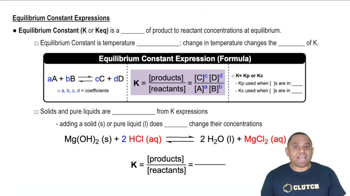
Equilibrium Constant (Kc)

The equilibrium constant (Kc) is a numerical value that expresses the ratio of the concentrations of products to reactants at equilibrium for a given reaction at a specific temperature. For the reaction N2(g) + 3 H2(g) ⇌ 2 NH3(g), Kc = [NH3]^2 / ([N2][H2]^3). A Kc value greater than 1 indicates that at equilibrium, products are favored over reactants.
Video consigliato:
Percorso guidato
03:20
Equilibrium Constant Expressions

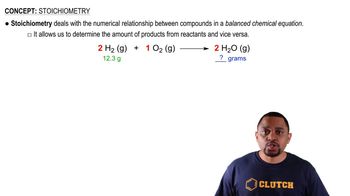
Stoichiometry

Stoichiometry involves the calculation of reactants and products in chemical reactions based on the balanced equation. In this case, the stoichiometric coefficients indicate that 1 mole of N2 reacts with 3 moles of H2 to produce 2 moles of NH3. Understanding stoichiometry is essential for determining the relationships between the amounts of substances involved in the reaction.
Video consigliato:
Percorso guidato
01:16
Stoichiometry Concept

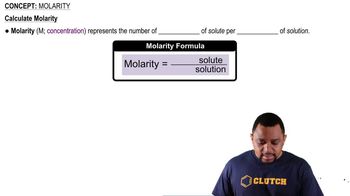
Molarity and Concentration

Molarity is a measure of concentration defined as the number of moles of solute per liter of solution. In this problem, the reaction occurs in a 1.00-L vessel, so the concentration of N2 can be directly equated to the number of moles present. This concept is crucial for calculating the equilibrium concentrations of all species involved in the reaction.
Video consigliato:
Percorso guidato
00:53
Molarity Concept