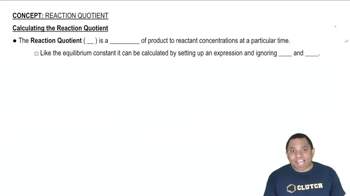
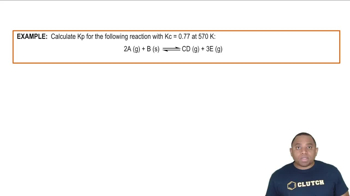
The reaction 2 AsH31g2 ∆ As21g2 + 3 H21g2 has Kp = 7.2 * 107 at 1073 K. At the same temperature, what is Kp for each of the following reactions? (a) As21g2 + 3 H21g2 ∆ 2 AsH31g2
Guida verificata passo dopo passo
1
Identify the reverse reaction. The given reaction is the reverse of the original reaction provided. In the original reaction, arsenic hydride (AsH3) decomposes into arsenic (As2) and hydrogen gas (H2). The reverse reaction combines arsenic and hydrogen gas to form arsenic hydride.
Understand the relationship between Kp of a reaction and its reverse. The equilibrium constant for the reverse reaction is the reciprocal of the equilibrium constant for the forward reaction.
Calculate the reciprocal of the given Kp. Since the reverse reaction's Kp is the reciprocal of the forward reaction's Kp, you need to find 1 divided by the given Kp value.
Apply the reciprocal to the given Kp value. Use the value of Kp = 7.2 * 10^7 for the forward reaction to find the Kp for the reverse reaction by calculating its reciprocal.
Interpret the result. The calculated Kp for the reverse reaction will indicate the equilibrium constant for the reaction where arsenic and hydrogen gas combine to form arsenic hydride at 1073 K.
Risposta video verificata per un problema simile:
Questa soluzione video è stata consigliata dai nostri tutor come utile per risolvere questo problema.
Durata del video:
1m
Guarda un video:
0 Commenti
Concetti chiave
Ecco i concetti essenziali che devi comprendere per rispondere correttamente alla domanda.
Equilibrium Constant (Kp)
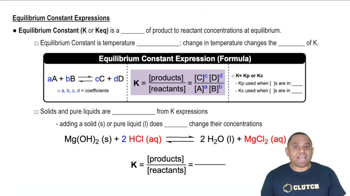
The equilibrium constant, Kp, is a numerical value that expresses the ratio of the partial pressures of the products to the reactants at equilibrium for a given reaction at a specific temperature. It is calculated using the formula Kp = (P_products) / (P_reactants), where P represents the partial pressures. A larger Kp indicates a greater concentration of products at equilibrium, while a smaller Kp suggests a higher concentration of reactants.
The reaction quotient, Q, is similar to the equilibrium constant but is calculated using the current concentrations or partial pressures of the reactants and products, regardless of whether the system is at equilibrium. By comparing Q to Kp, one can determine the direction in which a reaction will proceed to reach equilibrium. If Q < Kp, the reaction will shift to the right (toward products), while if Q > Kp, it will shift to the left (toward reactants).
When a chemical reaction is reversed, the equilibrium constant for the new reaction is the inverse of the original reaction's equilibrium constant. For example, if the original reaction has Kp = 7.2 * 10^7, then the equilibrium constant for the reverse reaction will be Kp' = 1 / (7.2 * 10^7). This principle is essential for calculating Kp for different reactions derived from a known reaction.


 Guida verificata passo dopo passo
 03:20
03:20