Ch.15 - Chemical Equilibrium

McMurry8th EditionChemistryISBN: 9781292336145
Non è quello che usi tu?Cambia libro di testoScegli un libro di testo diverso
TOC.tableOfContents
- Ch.1 - Chemical Tools: Experimentation & Measurement170
- Ch.2 - Atoms, Molecules & Ions160
- Ch.3 - Mass Relationships in Chemical Reactions169
- Ch.4 - Reactions in Aqueous Solution199
- Ch.5 - Periodicity & Electronic Structure of Atoms102
- Ch.6 - Ionic Compounds: Periodic Trends and Bonding Theory92
- Ch.7 - Covalent Bonding and Electron-Dot Structures61
- Ch.8 - Covalent Compounds: Bonding Theories and Molecular Structure59
- Ch.9 - Thermochemistry: Chemical Energy122
- Ch.10 - Gases: Their Properties & Behavior155
- Ch.11 - Liquids & Phase Changes54
- Ch.12 - Solids and Solid-State Materials73
- Ch.13 - Solutions & Their Properties120
- Ch.14 - Chemical Kinetics98
- Ch.15 - Chemical Equilibrium125
- Ch.16 - Aqueous Equilibria: Acids & Bases110
- Ch.17 - Applications of Aqueous Equilibria147
- Ch.18 - Thermodynamics: Entropy, Free Energy & Equilibrium86
- Ch.19 - Electrochemistry154
- Ch.20 - Nuclear Chemistry96
- Ch.21 - Transition Elements and Coordination Chemistry156
- Ch.22 - The Main Group Elements187
- Ch.23 - Organic and Biological Chemistry51

Capitolo 15, Problema 5
The reaction A21g2 + B21g2 ∆ 2 AB1g2 has an equilib- rium constant Kc = 9. The following figure represents a
reaction mixture that contains A2 molecules (red), B2 mol- ecules (blue), and AB molecules. What statement about the mixture is true? (LO 15.5) 
(a) The mixture is at equilibrium, and there will be no net shift in reaction direction.
(b) The reaction will shift toward the reactants to reach equilibrium.
(c) The reaction will shift toward the products to reach equilibrium.
(d) More information is needed to answer this question.
 Guida verificata passo dopo passo
1
Step 1: Identify the number of each type of molecule in the image. Count the number of A2 (red), B2 (blue), and AB (yellow) molecules.
Step 2: Write the expression for the equilibrium constant Kc for the reaction A2(g) + B2(g) ⇌ 2 AB(g). The expression is Kc = [AB]^2 / ([A2][B2]).
Step 3: Calculate the initial concentrations of A2, B2, and AB using the counts from the image. Assume the volume of the container is constant.
Step 4: Substitute the concentrations into the equilibrium constant expression to determine the reaction quotient Qc.
Step 5: Compare Qc to Kc. If Qc < Kc, the reaction will shift toward the products. If Qc > Kc, the reaction will shift toward the reactants. If Qc = Kc, the system is at equilibrium.
Risposta video verificata per un problema simile:
Questa soluzione video è stata consigliata dai nostri tutor come utile per risolvere questo problema.

Durata del video:
4mConcetti chiave
Ecco i concetti essenziali che devi comprendere per rispondere correttamente alla domanda.
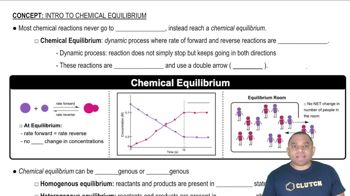
Chemical Equilibrium
Chemical equilibrium occurs when the rates of the forward and reverse reactions are equal, resulting in constant concentrations of reactants and products. In this state, the system appears static, but molecular activity continues. Understanding this concept is crucial for determining whether a reaction mixture is at equilibrium or if it will shift in response to changes in concentration, temperature, or pressure.
Video consigliato:
Percorso guidato
 04:21
04:21
Chemical Equilibrium Concepts
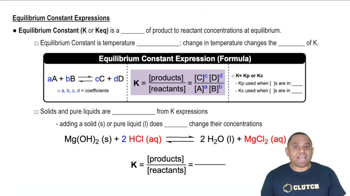
Equilibrium Constant (Kc)
The equilibrium constant (Kc) quantifies the ratio of the concentrations of products to reactants at equilibrium for a given reaction at a specific temperature. A Kc value greater than 1 indicates that products are favored at equilibrium, while a value less than 1 suggests that reactants are favored. In this case, Kc = 9 implies that the formation of AB is favored, which is essential for predicting the direction of the reaction shift.
Video consigliato:
Percorso guidato
 03:20
03:20Equilibrium Constant Expressions
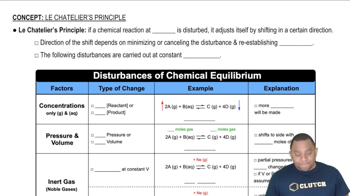
Le Chatelier's Principle
Le Chatelier's Principle states that if a dynamic equilibrium is disturbed by changing the conditions, the system will adjust to counteract the change and restore a new equilibrium. This principle helps predict how a reaction will shift in response to changes in concentration, pressure, or temperature. In the context of the question, it is vital for determining whether the reaction will shift toward reactants or products based on the current concentrations of A2, B2, and AB.
Video consigliato:
Percorso guidato
 07:32
07:32Le Chatelier's Principle
Pratica correlata