Ch.16 - Aqueous Equilibria: Acids & Bases
McMurry - Chemistry 8th Edition
McMurry8th EditionChemistryISBN: 9781292336145Non è quello che usi tu?Cambia libro di testo
Capitolo 16, Problema 17-148e

A 40.0 mL sample of a mixture of HCl and H3PO4 was titrated with 0.100 M NaOH. The first equivalence point was reached after 88.0 mL of base, and the second equivalence point was reached after 126.4 mL of base.
(e) Sketch the pH titration curve, and label the buffer regions and equivalence points.

Guida verificata passo dopo passo
1
Identify the acids in the mixture: HCl is a strong acid, and H3PO4 is a triprotic acid with three dissociation steps.
Understand that the first equivalence point corresponds to the neutralization of HCl and the first dissociation of H3PO4.
Recognize that the second equivalence point corresponds to the neutralization of the second dissociation of H3PO4.
Sketch the titration curve with volume of NaOH on the x-axis and pH on the y-axis. Start with a low pH due to the presence of strong acid HCl.
Label the first equivalence point at 88.0 mL and the second equivalence point at 126.4 mL. Indicate buffer regions between these points where the pH changes more gradually.

Risposta video verificata per un problema simile:

Questa soluzione video è stata consigliata dai nostri tutor come utile per risolvere questo problema.
Durata del video:
4m

Concetti chiave

Ecco i concetti essenziali che devi comprendere per rispondere correttamente alla domanda.

Titration and Equivalence Points

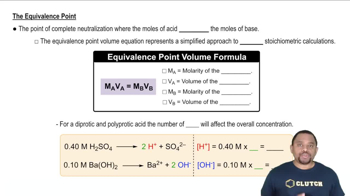
Titration is a quantitative analytical method used to determine the concentration of a solute in a solution. The equivalence point in a titration occurs when the amount of titrant added is stoichiometrically equivalent to the amount of substance in the sample. In this case, the first and second equivalence points indicate the complete neutralization of HCl and H3PO4, respectively, by NaOH.
Video consigliato:
Percorso guidato
03:06
Equivalence Point in Titration

pH and Buffer Regions

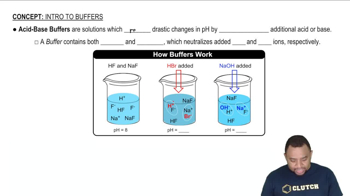
pH is a measure of the acidity or basicity of a solution, with lower values indicating acidic conditions and higher values indicating basic conditions. Buffer regions in a titration curve are areas where the pH changes gradually, typically occurring before and after the equivalence points. These regions are important for understanding how the solution resists changes in pH due to the presence of weak acids or bases.
Video consigliato:
Percorso guidato
03:02
Buffer Solutions

Titration Curves for Polyprotic Acids

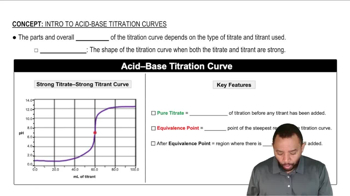
Polyprotic acids, like H3PO4, can donate more than one proton, leading to multiple equivalence points in a titration curve. Each equivalence point corresponds to the complete neutralization of one acidic proton. The shape of the titration curve reflects these transitions, showing steep rises at equivalence points and flatter regions in between, which are critical for identifying the behavior of the acid during titration.
Video consigliato:
Percorso guidato
02:16
Acid-Base Titration Curves